If you finished your PhD inside the German higher education system and you are now dreaming of building a research career in Germany, you have probably come across the DAAD PRIME programme in your search. Before you get too excited, there is something many guides do not tell you clearly enough: PRIME is not a general postdoctoral scholarship open to any researcher in the world who wants to move to Germany. It is designed specifically for people who already have a foot in German academia.
That single detail changes who should even bother applying, so let us start there before getting into dates, money and paperwork.
Who PRIME Is Actually Built For
PRIME stands for Postdoctoral Researchers International Mobility Experience. It is run by the German Academic Exchange Service, known as DAAD, and funded by the German Federal Ministry of Research, Technology and Space (BMFTR).
The programme gives postdocs a fixed term position that combines two phases:
- A 12 month research posting abroad, at an institution outside Germany
- A six month integration phase back at a German university afterward
Together that is an 18 month employment contract on the German TV L13 pay scale, plus an expatriate allowance during the time you spend abroad. The goal is straightforward: help talented postdocs sharpen their independence as researchers through an international stay, while keeping their long term career plans anchored in Germany.
For the newest application round, DAAD has tightened who qualifies. You must have been studying or working within the German higher education or research system for at least three of the past five years. That includes time spent in a doctoral program or on research activities based in Germany. If your PhD and recent research life have happened entirely outside Germany, this particular round will not be the right fit, even though there is no restriction based on your nationality or current country of residence.
Also Check: Deakin University Postgraduate Research Scholarship (DUPR)
What You Actually Get If You Are Selected
- An 18 month employment contract under TV L13, Germany’s standard pay scale for postdoctoral researchers
- An expatriate allowance for the 12 months you spend at your host institution abroad, calculated according to Annex VI.1 to Section 53 of the German Federal Remuneration Act (BBesG)
- A structured path back into German academia through the six month integration phase
- The chance to run your own independent research project rather than working under someone else’s grant
There are no restrictions tied to your passport or where you currently live. The one place nationality does matter is when you are choosing your destination country for the phase abroad, since some countries carry travel or research restrictions depending on your citizenship or residency status. It is worth checking this early rather than after you have already found a host abroad.
Just How Competitive Is PRIME
Here is a number every applicant should sit with before writing a single word of their proposal: the PRIME funding ratio has rarely gone above 12 percent. In plain terms, out of every 100 strong applications DAAD receives, roughly 88 are turned down.
DAAD itself is upfront that it only wants to fund applicants with an outstanding academic record, proposals that are genuinely well written, and projects that bring something new to the table rather than a safe, incremental idea. If your proposal reads like a routine continuation of your doctoral work, it is unlikely to stand out in a pool this selective.
Key Dates for the 2027 Application Cycle
Mark these carefully, because the runway from application to actually starting your fellowship is unusually long, almost a full year in some cases.
- Publication of the official call: Autumn 2026
- Online information session: Autumn 2026
- Application portal opens: January 2027
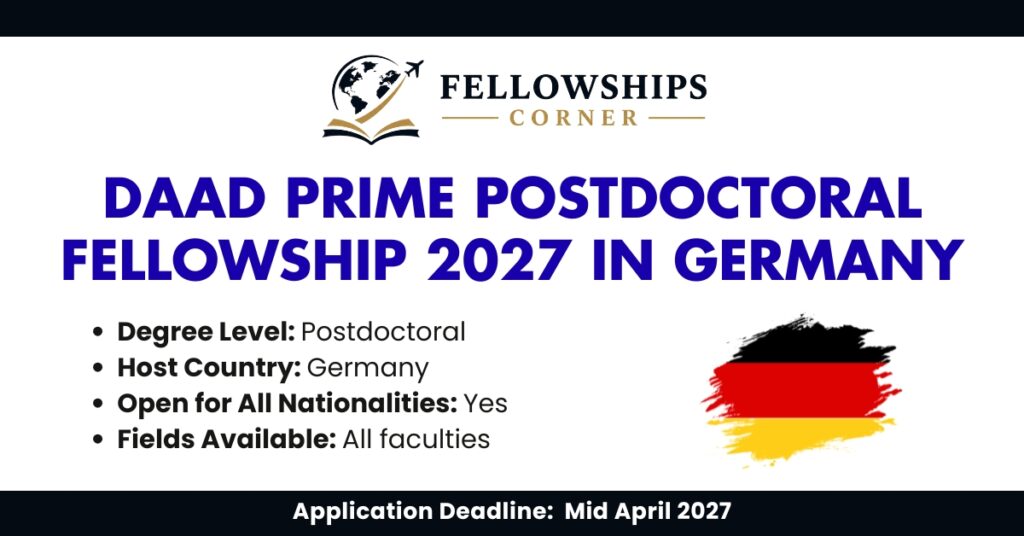
- Application deadline: mid April 2027
- Earliest possible start date for funding: 1 April 2028
- Latest possible start date for funding: 1 September 2028
DAAD has also flagged that its PRIME web pages will be under construction over the coming months, so details may shift slightly as the 2027 cycle approaches. It is worth bookmarking the official page and checking back closer to autumn 2026 rather than relying only on this summary.
Also Check: Rowland Fellows Program 2027 at Harvard University, United States
How to Apply, Step by Step
- Head to the DAAD scholarship database portal and search for the programme.
- Fill in your subject area (Fachrichtung), your intended destination country for the phase abroad (Zielland), and select “Programme für: Promovierte” since PRIME is for postdoctoral, not doctoral, applicants.
- Register an account on the portal. Choose English as the portal language, and if your browser gives you trouble displaying the site correctly, switch on compatibility view and set your browser language to English too.
- Once registered, click the “personal funding” tab to reach the actual application form.
- Complete every section of the form and attach all required documents before the mid April 2027 deadline.
Do not leave this until the last week. A complete application depends on paperwork from two separate universities, and chasing signatures at the last minute is the single most common reason strong candidates miss out.
Also Check: Institut Courtois Postdoctoral Fellowship 2026 in Canada
Documents You Need Before You Apply
Start gathering these early, since two of them require input from people outside your control.
- Declaration from your German host university (Form 1), available as a Word document or PDF
- Invitation from your German host (Form 2), a PDF that also serves as guidance for the host institution itself
- Ethics Issues Checklist (Form 3), available as a Word document or PDF
- Checklist of Application Documents (Form 4), a PDF you can use to confirm nothing is missing before you submit
Because Form 1 and Form 2 both depend on your German host university actually issuing an invitation and signing off, reach out to your prospective hosts well before the deadline. Universities have their own internal processes and cannot always turn these documents around quickly.
Also Check: AMBER Postdoctoral Fellowship
Finding the Right Host Institutions
- You are responsible for making contact with both your German host university and your foreign host institution yourself. DAAD does not place you.
- A good starting point is GERiT, short for German Research Institutions, a joint service run by the German Research Foundation (DFG), the German Rectors’ Conference (HRK) and DAAD. It gives a clear overview of research priorities and existing international partnerships across German universities, which can help you identify institutions already active in your field.
- Some German universities have named a specific contact person for PRIME applicants, and DAAD publishes that list on its site. That said, do not assume a university is off limits just because it has not nominated a contact. Any German university is eligible to serve as a host institution for PRIME, whether or not it appears on that list.
- When you do reach out, keep in mind what host institutions are actually being asked to provide. DAAD expects the research environment, both in Germany and abroad, to genuinely help you gain new scientific or methodological skills, grow into an independent researcher, and become a serious contender for more senior academic positions afterward. Framing your outreach around those three outcomes, rather than simply asking for a signature, tends to land better with potential hosts.
Also Check: Humboldt Research Fellowship (Postdoctoral Research in Germany)
Tips to Strengthen Your Application
- Lead with what makes your project genuinely new. Reviewers are explicitly told to favor highly innovative projects over incremental ones.
- Get your host university conversations started the moment the portal opens in January 2027, not in March.
- Double check any nationality or residency related travel restrictions for your chosen destination country before you commit to a host abroad.
- Use the Form 4 checklist as your final review tool a few days before the deadline, not the night before.
- Treat the six month German integration phase as part of your pitch, not an afterthought. Explain how it connects back to your long term goals in German academia.
Frequently Asked Questions:
What is the DAAD PRIME programme
PRIME, short for Postdoctoral Researchers International Mobility Experience, is a DAAD funded position for postdoctoral researchers that combines a 12 month research stay abroad with a six month integration phase at a German university. It is aimed at researchers who plan to build their long term academic career in Germany.
Who can apply for a PRIME fellowship
Applicants from any faculty with above average academic qualifications can apply, provided they completed their doctorate with excellent results before their funding start date. For the upcoming cycle, you also need to have spent at least three of the past five years studying or working within the German higher education or research system.
Do I need to be a German citizen to apply
No. There is no restriction based on nationality or where you currently live. The only place your citizenship or residency can matter is in choosing your destination country for the phase abroad, since some countries have their own entry or research restrictions depending on your background.
What funding does PRIME provide
Selected fellows receive an 18 month employment contract under the TV L13 pay scale, along with an expatriate allowance during the 12 months spent at the host institution abroad.
How selective is PRIME really
Very. DAAD reports that the funding ratio has rarely exceeded 12 percent, meaning the large majority of applications, even strong ones, do not receive funding.
When are the next PRIME deadlines
The application portal opens in January 2027, and the application deadline is mid April 2027. Funding can begin as early as 1 April 2028 and no later than 1 September 2028.
What documents do I need before I apply
You will need a Declaration from your German host university, an Invitation from that host, an Ethics Issues Checklist, and the Checklist of Application Documents. The first two depend on your German host university, so start those conversations early.
How do I find a host university in Germany
You are responsible for contacting institutions yourself. GERiT, a joint DAAD, DFG and HRK service, is a useful starting point for identifying German universities active in your research field. You can also check DAAD’s list of named PRIME contacts, though universities without a listed contact remain eligible hosts as well.
PRIME is a serious opportunity for postdocs who already have real ties to German research and want to use an international stay to accelerate their academic career. It is not, however, a fellowship for postdocs looking to enter German academia for the first time.
If the three out of five year rule describes your background, start reaching out to potential German and international host institutions well before the portal opens in January 2027, since the paperwork alone can take months to complete. For full official details and updates as the pages are finalized, visit the DAAD PRIME programme page and the PRIME FAQ.
Also Check: KWI International Fellowships 2027 in Germany