
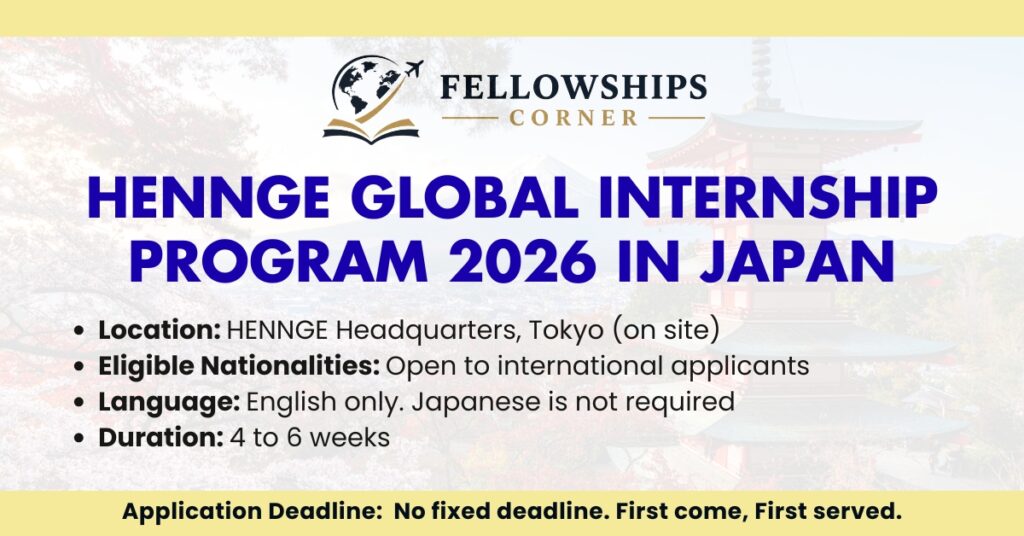
Here is something most students do not expect to hear about a tech internship in Tokyo: you do not need to speak a word of Japanese to get in.
The HENNGE Global Internship Program, usually shortened to GIP, runs entirely in English at the company’s headquarters in Tokyo. Your mentors speak English. Your daily standups happen in English. Your code reviews happen in English. For a lot of international students, that single fact removes the biggest barrier they thought stood between them and working in Japan.
But there is a second thing you should know before you get excited, and it is the reason this article is worth reading to the end. Seats are filled on a first come, first served basis, and slots can close up to four months before a batch even begins. Students who wait for a “deadline” that never gets announced are the ones who miss out.
Why Timing Matters More Than Anything Else Here
Most scholarships and internships have a hard closing date. This one does not work that way.
HENNGE reviews applications as they arrive. Once a batch fills, that batch closes, regardless of how many weeks remain on the calendar. The official guidance says slots may close as early as four months before the start date.
So if you are reading this and a batch below looks like a fit, the correct move is to start the application today rather than bookmark it for later.
Internship Schedule
| Pathway | Batch | Dates | Length |
|---|---|---|---|
| Front End Pathway (2026) | Batch 5 | Nov 16 to Dec 18, 2026 | 5 weeks |
| Full Stack Pathway (2027) | Batch 1 | Jan 18 to Feb 19, 2027 | 5 weeks |
| Full Stack Pathway (2027) | Batch 2 | Jun 1 to Jul 16, 2027 | 7 weeks |
A few practical notes on the schedule:
- You indicate your preferred batches after you finish the coding challenge, not before.
- You can select multiple batches in a single application as long as they belong to the same pathway. A Full Stack applicant may choose Batch 1 and Batch 2 together.
- You cannot mix pathways in one application. More on that in a moment.
The Application Process, Step by Step
The process has three stages, and each one filters differently. Knowing what each stage is actually testing will save you a lot of guesswork.
Step 1: Register and verify your email
You sign up through the official application page and confirm your email address. Simple, but it is where your pathway choice gets locked in.
Step 2: Solve the coding challenge and upload your documents
This is the real gate. You complete the coding challenge, then submit it along with your CV and cover letter.
Two details here that applicants frequently get wrong:
- The coding challenge has no time limit, and how fast you solve it is not part of the evaluation. Take the time to write clean, well reasoned code instead of rushing.
- Your application is not considered complete until you have uploaded your documents and filled in your batch preferences. Solving the challenge alone does not put you in the queue.
Step 3: Interviews
Candidates who clear Step 2 move to an HR interview, followed by an online technical interview.
Also Check: The World Bank Group Pioneers Internship Program 2026
Your CV and Cover Letter Carry Real Weight
HENNGE has been direct about this: generic submissions do not reflect your potential well. They want to see your story explained clearly, with specific experiences rather than recycled phrasing.
If you have ever copied a cover letter template, swapped the company name, and sent it off, this is the program where that habit will cost you. The company publishes its own guide on writing a strong cover letter, and reading it before you draft anything is one of the cheapest advantages you can give yourself:
https://hennge.com/global/info/henka/interview/202403-crafting-the-perfect-cover-letter
Choosing Between the Two Pathways
Every applicant must pick at least one pathway, and the two run on completely different schedules with completely different coding challenges.
Full Stack Engineering Pathway
You build and connect complete applications, designing back end APIs and front end interfaces while working through core concepts like security, state management, and testing across a cloud integrated stack. You also spend time in Unix like environments and DevOps tooling, with a mentor giving you feedback on your technical decisions and trade offs.
Internship flow:
- Weeks 1 to 3: Full Stack Application Development Project
- Week 4: DevOps and Infrastructure Project
- Weeks 5 and 6 (conditional): Special Assignment, unique to each intern and specific to their batch
Front End Engineering Pathway
You develop front end applications in TypeScript using React or Vue, going deep on state management and data fetching while learning how your work connects to back end services and cloud infrastructure. A big part of this track is defending your technical choices in review sessions and then improving your implementation based on that feedback.
Internship flow:
- Weeks 1 to 4: Application Development Training
- Week 5: DevOps Project
Three Rules About Pathways You Should Not Ignore
- Each pathway has its own coding challenge. They are not interchangeable.
- If you want to apply to both, you must submit two separate applications using two different email addresses.
- Once you are enrolled, you cannot switch pathways midway through the program.
Think carefully before you choose. Picking the track you are genuinely stronger in usually beats picking the one that sounds more impressive.
Also Check: Procter & Gamble (P&G) Paid Internship Program 2026
Who Can Apply
Both pathways share the same core requirements.
Essential for every applicant:
- Third year undergraduate or above, including Master’s and Doctoral students. Recent graduates are welcome to apply.
- Pursuing or holding a degree in Computer Science or a related field. If not, equivalent experience from a tech internship or bootcamp is expected.
- Fluency in English. Japanese is not required.
- Knowledge of Linux, MacOS, or other Unix like environments.
- Interest in open source or tech community activities.
- Interest in building a career in Japan.
Programming requirement, by pathway:
- Full Stack applicants need proficiency in Python, Go, or React and Vue in TypeScript.
- Front End applicants need proficiency in front end frameworks such as React or Vue in TypeScript, ideally with an understanding of building at scale, including form validation, data fetching, and state management.
Plus at least three of the following. Full Stack applicants choose from this list:
- Experience with cloud platforms, especially AWS
- Experience in full stack web application development
- Knowledge of distributed systems
- Knowledge of DevOps tools and practices such as CI/CD and Infrastructure as Code
- Knowledge of container technology such as Docker
Front End applicants have a wider list to choose three from:
- Experience with cloud platforms, especially AWS
- Experience in full stack web application development
- Proficiency in Python or Go
- Knowledge of distributed systems
- Knowledge of DevOps tools and practices such as CI/CD and Infrastructure as Code
- Experience with software testing methodologies including unit, integration, and end to end testing
- Experience with UI and UX design tools, especially Figma
- Experience implementing responsive web design in a web app
- Experience implementing single sign on in a web app
Notice what the front end list is really saying. HENNGE states plainly that its ideal front end candidate is more than a front end developer: someone with back end or full stack exposure, familiarity with DevOps practices, an eye for thoughtful UI and UX, and a habit of building complete products rather than isolated components.

What You Get: Unpaid, But Heavily Subsidised
This is the part that confuses people, so let us be precise about it.
The internship itself is unpaid. HENNGE does not hide this. What the company does instead is cover the costs that usually make an overseas internship impossible for a student.
Interns are provided with:
- A monthly subsidy
- Pre arrival support and visa guidance
- Round trip airfare
- Medical insurance (provided only to interns who do not already reside in Japan)
- A Japanese mobile phone with a data plan
Interns also get access to:
- Informal luncheons designed to help you meet the team
- Monthly technical sessions where engineers share knowledge and current trends
- Office facilities, refreshments, staff parties, and plenty of social opportunities
- Japanese cultural events
Do the arithmetic before you dismiss an unpaid role. Flights to Tokyo, five weeks of accommodation costs offset by a subsidy, insurance, and a working phone add up to a package many paid internships elsewhere do not match.
There is also a longer term angle worth taking seriously. This program is explicitly part of HENNGE’s pre hiring process, and outstanding participants may receive full time employment offers. If your goal is to work in Japan as an engineer, this is a direct route in.
Working Hours and What Daily Life Looks Like
The program runs Monday to Friday, 10:00 to 19:00 JST, on site in Tokyo.
Check this against your university timetable before applying. Interns are expected to be present and engaged throughout, and a clash with coursework, exams, or another commitment is a problem you want to identify now rather than after you have accepted a place.
You will be working alongside the wider engineering team rather than sitting in a separate intern bubble, communicating daily with mentors and peers. The emphasis is on your growth in engineering fundamentals, problem solving, and collaboration rather than on shipping production features.
Curious about the technologies you would be touching? HENNGE publishes its stack here: https://stackshare.io/hennge/hennge-global-internship-program
How to Give Yourself a Real Advantage
A few things separate strong applicants from the rest in a program structured like this one.
- Apply early in the cycle, not late. With first come, first served allocation, an average application submitted in month one often beats a polished one submitted in month five.
- Use the unlimited coding challenge properly. No time pressure means no excuse for messy code, missing edge cases, or absent documentation. Reviewers see the finished artifact, not your clock.
- Write the cover letter for HENNGE specifically. Reference the pathway you chose and why. Reference something from their stack or their engineering culture. Vagueness is the fastest way to blend into a pile.
- Show your open source or community involvement. It appears in the essential requirements for a reason. A GitHub profile with real commits, a meetup you help organise, a technical blog, all of it counts.
- Be honest about the “three of the following” list. Claiming Docker experience you do not have will surface in the technical interview.
- Apply to more than one batch where allowed. If you qualify for both Full Stack batches, selecting both widens your chances at no extra cost.
A Quick Word on Avoiding Scams
Programs offering flights and visa support to Japan attract imitators. Apply only through HENNGE’s official recruitment channels and their official careers domain. No legitimate internship will ask you to pay a processing fee, an application fee, or a visa deposit to a personal account. If a message asks you for money or for banking details before you have even interviewed, stop and verify it against the official site.
Frequently Asked Questions:
Do I need to speak Japanese to join the HENNGE Global Internship Program?
No. The program is conducted in English and Japanese language ability is not required. Japanese is only required for HENNGE’s non technical business roles aimed at new graduates, which are listed separately at https://recruit.hennge.com/new-graduates/
Is the HENNGE internship paid?
No, the internship itself is unpaid. However, HENNGE provides a monthly subsidy, round trip airfare, visa guidance, medical insurance for interns who do not live in Japan, and a Japanese mobile phone with data.
Can I apply to both the Full Stack and Front End pathways?
Yes, but not in a single application. Each pathway has its own coding challenge, so you must submit two separate applications using two different email addresses.
What is the deadline to apply?
There is no fixed public deadline. Applications are reviewed as they arrive and batches close once all slots are filled, potentially up to four months before the batch start date. Applying early is strongly advised.
Am I eligible as a recent graduate?
Yes. Recent graduates are welcome to apply, alongside third year undergraduates and above, including Master’s and Doctoral students.
Do I need a Computer Science degree?
A degree in Computer Science or a closely related field is expected. If you do not have one, equivalent practical experience from a tech internship or a coding bootcamp is accepted.
How long do I have to complete the coding challenge?
There is no time limit, and your solving speed is not factored into the evaluation. Focus on quality rather than speed.
Can I change my pathway after being accepted?
No. Once you are enrolled in the program, switching pathways partway through is not permitted.
How long does the internship last?
Program length varies by batch. The listed batches run for 5 weeks, with one 2027 Full Stack batch running 7 weeks. Working hours are 10:00 to 19:00 JST, Monday to Friday.
Does completing the internship lead to a job at HENNGE?
It can. The program forms part of HENNGE’s pre hiring process, and standout participants may be offered full time positions. There is no automatic guarantee.
If you are an engineering student who has ever thought about working in Japan and assumed the language barrier ruled you out, the HENNGE Global Internship Program is one of the clearest openings available. English throughout, a mentor assigned to you, flights and visa help covered, and a genuine path into full time employment at the end.
The catch is not the difficulty. It is the timing.
Pick your pathway, open the coding challenge today, give it the care an unlimited time limit deserves, and get your documents and batch preferences submitted. In a first come, first served process, the applicant who starts this week is already ahead of the one who starts next month.