Here is something that surprises a lot of physicists the first time they look seriously at this scheme. The hardest gate in the Ernest Rutherford Fellowship is not the review panel. It is getting a UK university to agree to put your name forward in the first place.
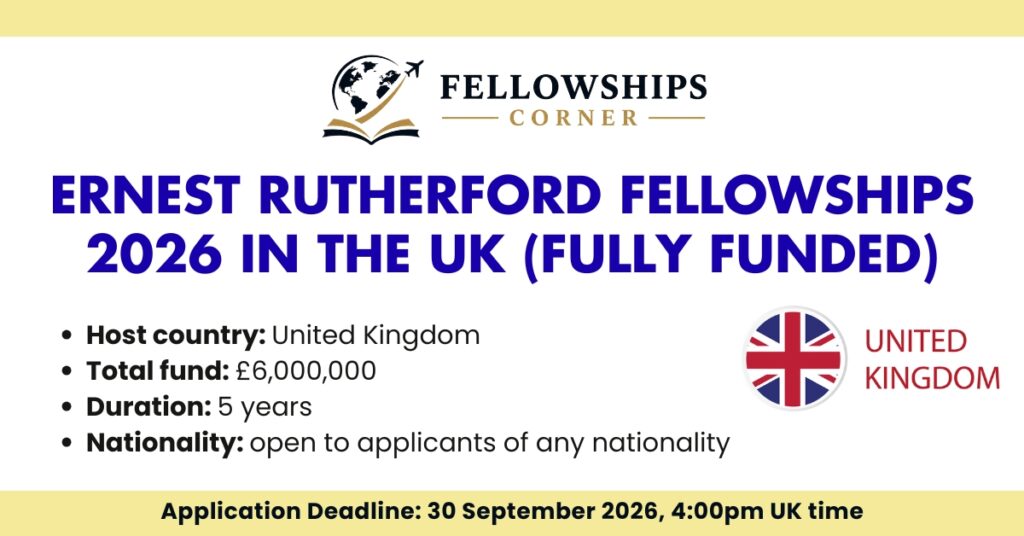
The Science and Technology Facilities Council (STFC) will fund up to 10 Ernest Rutherford Fellowships in the 2026 round, drawing on a total pot of £6 million. Each award runs for five years and covers salary, travel and modest equipment costs at 80 percent of full economic cost, with the host institution paying the rest. It is one of the most respected early independence awards in UK physics, and it is deliberately small.
That scarcity shapes everything about how you should approach it. Below is a practical walkthrough of the 2026 cycle: the quota system nobody warns you about, the money, the eligibility rules that quietly disqualify people, what each application section actually wants, and how the whole thing is assessed.
The quota gate: why your host institution matters more than you think
STFC does not accept applications directly from individuals. Your application must be submitted by a UK research organisation that holds an ERF application quota, and that quota strictly limits how many candidates each institution can put forward.
What this means in practice:
- If your proposed host does not hold an ERF quota, your application will be rejected outright, no matter how strong the science is.
- Institutions that exceed their limit are required to withdraw the extra applications.
- Most quota holding departments run an internal selection process, and those internal deadlines usually fall weeks before STFC’s own closing date.
- You need written assurance from your proposed host that your application fits inside their allocation. A friendly conversation is not the same thing.
STFC publishes a list of research organisations holding a quota, along with named contacts and internal deadlines, on the official opportunity page. Check that list before you invest weeks in writing.
One more detail worth knowing: host organisations were told they should not expect candidates to accept a hosting offer before 17 July 2026. If a department pressured you for an early commitment, that was against the guidance.
Host organisations also carry a separate obligation. Each one must complete an online survey describing the inclusive process it used to select candidates, submitted by 30 September 2026. This equality, diversity and inclusion statement is mandatory. If a research organisation fails to submit one, or submits an inadequate one, applications coming from that institution will not be considered until an acceptable statement arrives. Your personal score is not affected by it, but your application can stall because of it, so it is reasonable to ask your research office whether they have handled it.
Where the 2026 cycle stands right now
The opportunity opened on 3 June 2026 and closes at 4:00pm UK time on 30 September 2026. There is no extension and no late submission. Once the clock passes that point, the Funding Service simply will not let you apply.
Full timeline for this round:
- 3 June 2026, 9:00am UK time: opening date
- 30 September 2026, 4:00pm UK time: closing date
- October 2026 to January 2027: external peer review
- January or February 2027: applicant response window (you get 14 days to reply to reviewer comments)
- March 2027: decision on who is invited to interview
- April or May 2027: interviews
- May or June 2027: awards announced
- By 31 March 2028: all funded projects must have started
Two things follow from that calendar. First, this is a long process. From submission to a signed offer is roughly eight to nine months, so you should plan your employment and visa situation with that lag in mind. Second, your real deadline is your institution’s internal one, not STFC’s. Work backwards from that date.
The money: what is covered and what is not
Fellowship applications are costed on full economic cost. STFC pays 80 percent of that figure. The host institution must fund the remaining 20 percent from its own resources, which is one reason departments are selective about who they back.
What the fellowship funds:
- Your salary, including employer national insurance and superannuation contributions, agreed in advance with your host and justified against their salary scale
- Salary increments across the five years, uplifted using standard UKRI indexation rates
- Personal travel and subsistence, guided at roughly £2,200 per year, covering collaborative visits, fieldwork and one conference, workshop or symposium annually
- Minor equipment and consumables up to a guided total of £5,000 for the whole five years
- Relocation and visa costs if you are moving to the UK from overseas, including the Immigration Health Surcharge and Certificate of Sponsorship, capped at £1,200 from Europe and £3,000 from outside Europe
- Retraining and skills updating if you are returning from a career break and can justify it against the project
- A laptop, where a higher specification is genuinely needed for tasks such as data modelling or enhanced graphics
- Reasonable adjustment costs that increase as a direct result of working on the project
What the fellowship does not fund:
- Postdoctoral research associates or PhD students. This is an award for one independent researcher, not a group leader starter package.
- Publication costs for peer reviewed journal articles and conference papers, since UKRI funds research organisations directly for this. Costs for books, monographs, critical editions and catalogues can still be claimed.
- Mentoring time.
The £2,200 travel figure and the £5,000 equipment figure are guidance levels rather than hard ceilings. If your work involves designing and building instrumentation, you can ask for more, but you must justify it clearly in the resources section. Vague requests get trimmed.
Also Check: KAUST Global Fellowship for Postdocs in Saudi Arabia ($75,000 Stipend)
Who can apply, and who is quietly ruled out
The headline requirement is simple. You need a doctorate, or evidence of equivalent research experience, and you need to be aiming to establish your own research niche and independence.
Notably, STFC sets no time limit on eligibility. There is no maximum number of years since your PhD and no minimum either. The scheme is also open to researchers, innovators, research technical professionals and research software engineers, not only conventional postdocs. Applicants of any nationality may apply.
You should be able to show:
- Skills, experience, career development and productivity across your previous appointments
- Research plans that are genuinely your own and do not significantly overlap with the plans of others in your group
- The backing of an eligible UK organisation holding an ERF quota
- Clear plans for a step change towards independence
You are not eligible if:
- You hold, or have held, a post at lecturer level or equivalent that allowed you to establish a research niche and independence
- You secure a lecturer level academic position before the fellowship offer is made, which makes you ineligible to hold the award
- You have another UKRI fellowship application under assessment
- You have applied for, or been awarded, another UKRI Early Independence Fellowship producing equivalent outcomes
- You have already received a comparable early independence fellowship or new investigator award from any organisation where you led grants as Project Lead and supported research staff such as postdoctoral associates, since that indicates you have already made the step to independence
If your situation sits in a grey area, email the STFC fellowships team at fellowships@stfc.ukri.org and get it confirmed in writing before you write a single page. This is the single most useful hour you can spend on the application.
Also Check: DAAD PRIME Postdoctoral Fellowship 2027 in germany (Fully Funded)
Flexibility that is genuinely available
- Fellowships can be held full time or part time, at 50 percent of full time equivalent or above, and the award period extends pro rata
- A part time fellow may not hold a second part time position alongside the fellowship
- Joint applications on a job share basis are permitted for this round, and both applicants can list themselves as the fellow
- UKRI offers disability and accessibility support during application and assessment
- Applications are welcome from people using the fellowship to re establish themselves in the UK after time overseas
- Successful applicants needing a visa can be considered under the Global Talent route, in the exceptional promise category for future research leaders
Resubmissions
If you applied in a previous ERF round and were unsuccessful, you can apply again in 2026 with the same, revised or entirely new project, provided you still meet the eligibility rules. There is one condition that trips people up: you must address the panel feedback you received. STFC reserves the right to reject an application that ignores previous panel comments. Also worth noting, the resubmission policy is under review and uninvited resubmissions may not be accepted in future rounds.
Does your science fit the remit?
The project must offer scope for original work and align with STFC’s strategic objectives and core business areas:
- Astronomy, solar and planetary science
- Particle physics
- Particle astrophysics
- Nuclear physics
- Accelerator science
- Computational science
- Quantum technologies
Multidisciplinary work that crosses into other research council territory is welcome, but the primary focus must sit inside STFC remit. Both theoretical and analytical projects and instrumentation, experiment or software development projects are in scope. If your work sits near a remit boundary, ask the fellowships mailbox before applying rather than gambling on it.
Inside the application: what each section is really asking
Everything goes through the UKRI Funding Service. The Joint Electronic Submissions system is no longer used. You complete the application, send it to your research office for checking, and they submit it. Only the lead research organisation can submit.
Here is the shape of what you will write.
Summary (550 words). Plain English, written for policymakers, the public and researchers outside your subfield. It is used to identify suitable reviewers and is usually published, so keep confidential material out of it. Cover context, the challenge, aims and objectives, and potential applications.
Vision and Approach (uploaded PDF, maximum 6 sides of A4). Single spaced, 11 point Arial or similar sans serif font, margins of at least 2cm, file under 8MB. Name the file using the Funding Service number the system gives you followed by the words Vision and Approach. Images, graphs and tables are allowed here. If the file breaks any of these rules, the application is rejected, so check the formatting twice.
The Vision half needs to show quality, importance, timeliness, and potential to advance understanding, plus impact on research, society, economy or environment, and how your work fits the international context and the STFC programme. The Approach half needs a methodology, a comprehensive risk assessment, a project plan with milestones and timelines presented as a chart or diagram, evidence of access to the facilities you need, and an honest balance of risk against reward across five years.
Data management and sharing (500 words). A plan showing compliance with the UKRI data sharing policy.
Applicant capability to deliver (1,650 words). This splits into 1,150 words of Résumé for Research and Innovation modules including references, plus an optional 500 words of Additions. Use each of the four R4RI headings once: contributions to new ideas, tools, methodologies or knowledge; development of others and effective working relationships; contributions to the wider research and innovation community; and contributions to broader research or innovation, users, audiences and wider societal benefit. Write it as narrative prose, not as a CV. The Additions section is for context such as career breaks, not for extra achievements.
Career development (1,000 words). Why this fellowship, at this moment, is the right vehicle for your growth. Set out realistic goals, the skills you will build in research, leadership, communication and management, your mentoring arrangements, and how you will drive positive change through equality and inclusion work, outreach, policy influence, review or public engagement.
Host organisation support (1,000 words). This must be written by the Head of Department and pasted into the text box. It cannot be uploaded as an attachment, and uploading it in the wrong place can get your application rejected. It should name the Head of Department, explain how the environment supports your career, confirm how your time on the fellowship will be protected, describe training and development on offer, and list the practical and financial support being provided.
Resources and cost justification (1,000 words). Justify only the more costly or unusual items. Assessors do not want a line by line budget.
Ethics and responsible research and innovation (500 words). If you believe there are no ethical issues, say so and explain why. Do not leave it blank.
Short answer sections. You will also classify your application by peer review area and by nature of research activity, list posts held since your PhD (100 words), state whether this is a resubmission from ERF 2025 (200 words), declare other funding support sought or received (150 words), and answer questions on Trusted Research and Innovation, animal involvement, genetically modified organisms and human participation.
Also Check: Deakin University Postgraduate Research Scholarship (DUPR)
Practical rules on references, links and images
- References go inside the word count of the relevant section, so choose them carefully and prioritise the most pertinent
- Persistent identifiers should be used where possible
- Hyperlinks may only point to reference information. You cannot use links to extend your application, and assessors are not required to click them
- Images need a descriptive caption underneath, outside the image, counting towards your word limit, and each image starts on a new line
- Files must be under 5MB in a standard image format
- Paragraphs of text, tables inside images, and excessive numbers of images will get your application rejected
How your application is assessed
Four assessment areas carry the decision: vision and approach, applicant capability to deliver, career development, and ethics and responsible research and innovation.
The process runs in three stages. External experts review your application independently against the published criteria, and you cannot nominate your own reviewers. You then get 14 days to respond to their comments, which is a genuine opportunity rather than a formality. The ERF panel then reads the application, the reviews and your response, ranks everything, and recommends who goes to interview. An expert interview panel meets shortlisted candidates in April or May 2027, and STFC makes the final call.
STFC supports the San Francisco Declaration on Research Assessment, meaning journal metrics are not the yardstick. Contribution and evidence are.
A firm word on generative AI
You are permitted to use generative AI tools when preparing your application, but UKRI advises caution and has a published policy on it. Reviewers and panellists, by contrast, are not allowed to use these tools at all when writing their assessments, because doing so could compromise the confidentiality of your ideas.
The practical advice is straightforward. A reviewer reading ten applications in a field they know intimately can tell when a research vision has no author behind it. Use AI for tidying and checking if you want. Do not use it to generate the intellectual core of a proposal that is meant to prove you can think independently.

Five things that separate strong applications from the rest
- Secure the host early and properly. The quota conversation should have happened months ago. If it has not, that is your first phone call today, not your last.
- Make the independence argument explicit. The scheme funds a step change towards your own niche. Reviewers want to see where your plans stop overlapping with your current supervisor or group, and you should state that plainly rather than hoping it is inferred.
- Treat the Head of Department statement as a real deliverable. It is 1,000 words written by someone else with a full diary. Give them a detailed brief, the assessment criteria, and at least three weeks.
- Put a real project plan in the PDF. A chart with milestones across five years signals feasibility better than any paragraph of prose. Vague timelines read as untested ideas.
- Address old panel feedback if you are resubmitting. Not addressing it is grounds for rejection, and it is one of the easiest failures to avoid.
Frequently asked questions:
How many Ernest Rutherford Fellowships are available in 2026?
STFC is offering up to 10 fellowships from a total fund of £6 million.
How long does the fellowship last?
Five years. Projects must start no later than 31 March 2028.
When is the deadline for the 2026 round?
Applications close at 4:00pm UK time on 30 September 2026. Your host institution’s internal deadline will be earlier, often by several weeks.
Can international researchers apply?
Yes. Fellowships are open to applicants of any nationality. If you need a visa to work in the UK, you will be considered under the Global Talent route in the exceptional promise category, and your visa and relocation costs can be included in the application within the published caps.
Is there a limit on years of postdoctoral experience?
No. STFC does not define eligibility by years since PhD. Read the assessment criteria and judge whether you have the skills, knowledge and experience to make a convincing case.
Can I apply if I already have a lecturer position?
No. If you hold or have held a post at lecturer level, or equivalent outside a university, that allowed you to build a research niche and independence, you are ineligible. If you take up such a post before the offer is made, you cannot hold the fellowship.
Can I fund a PhD student or postdoc with this award?
No. The Ernest Rutherford Fellowship supports one independent researcher. Costs for postdoctoral research associates and PhD students cannot be requested.
Can I hold the fellowship part time?
Yes, at 50 percent of full time equivalent or above, with the award period extended pro rata after discussion with STFC. You cannot hold another part time role alongside it. Job share applications are also accepted in this round.
Can I apply again if I was unsuccessful before?
Yes, provided you still meet the eligibility criteria. You must address any panel feedback from your previous attempt, since ignoring it can lead to rejection. Be aware that STFC is reviewing this policy and uninvited resubmissions may not be allowed in future rounds.
Who pays the other 20 percent of the cost?
The host research organisation. This is a standard requirement and there is no expectation of additional matched funding beyond it.
What if I need to tell STFC something confidential?
Email fellowships@stfc.ukri.org with the opportunity title, the words sensitive information, and your Funding Service application number in the subject line. Typical examples include declarations of interest, parental leave dates, or notifying an invited resubmission.
Where do I go if the Funding Service itself has a problem?
Use the UKRI Funding Service helpdesk contact details published on the opportunity page. Phone lines run Monday to Thursday 8:30am to 5:00pm and Friday 8:30am to 4:30pm, on 01793 547490. Include the council name, opportunity name and your application reference in any email, and avoid contacting several mailboxes at once.
Ten awards, five years of protected salary, and a route to independence in a field where independence is hard to come by. The Ernest Rutherford Fellowship is worth the effort, but it rewards people who start early and treat the host relationship as the first stage of the competition rather than an administrative formality.
If you are considering the 2026 round, do these two things this week. Check whether your intended department holds an ERF quota and find out its internal deadline. Then email fellowships@stfc.ukri.org with any eligibility doubt you have, so you are building on solid ground.
Full official guidance, the quota list with named institutional contacts, and the application portal are all available through the UKRI Funding Finder page for Early Independence: Ernest Rutherford Fellowships 2026. Always verify dates and requirements against the official page before submitting, since funders can update guidance mid cycle.
Also Check: Rowland Fellows Program 2027 at Harvard University, United States