The Rowland Institute has a rich history of fostering creative, boundary-pushing science. Edwin Land, the inventor and founder of Polaroid Corporation, established the Rowland Institute of Science in 1980. His vision was to create a space for high-risk, high-reward research free from conventional academic pressures.
In 2002, the institute joined Harvard University, becoming the Rowland Institute at Harvard. This partnership combined the institute’s independent spirit with Harvard’s vast resources. In 2024, the institute relocated to Harvard’s main campus at 60 Oxford Street, enhancing collaboration opportunities with university departments and facilities.
The institute prioritizes interdisciplinary work. It encourages scholars to explore fields that bridge traditional disciplines, such as combining physics with biology or engineering with neuroscience. Past fellows have made significant contributions, and many have built successful careers in academia, industry, and entrepreneurship. Alumni include leaders who have founded startups and secured prominent faculty positions worldwide.
The Rowland Fellows Program embodies this legacy. It selects candidates based on the strength and originality of their proposed research. The program values bold ideas that push scientific boundaries while maintaining a focus on experimental approaches.
Uniqueness of Rowland Fellows Program:
Unlike many postdoctoral fellowships that tie researchers to existing labs, the Rowland Fellowship grants you complete independence. You will design your own research program, build your team, and manage your laboratory from day one.
This independence is paired with unparalleled support. Fellows benefit from a collaborative, interdisciplinary community in Cambridge, Massachusetts, a global hub for science and innovation. Proximity to Harvard’s resources, including world-class libraries, computing facilities, and core research centers, amplifies your potential.
The program also emphasizes long-term success. Through mentoring, leadership training, and professional development, fellows gain skills essential for thriving in academia or beyond.
Also Check: Institut Courtois Postdoctoral Fellowship 2026 in Canada
What they Offer:
The fellowship offers comprehensive support designed to remove financial and logistical barriers so you can focus entirely on research.
- Full principal investigator rights, allowing you to lead your own independent research group.
- Dedicated laboratory space tailored to your needs, plus ancillary spaces such as tissue culture rooms if required.
- Generous start-up funding for capital equipment, customized to your research program.
- Annual operational budget starting at $225,000, covering lab supplies, travel, and hiring personnel including postdoctoral fellows, post-baccalaureate researchers, and undergraduates.
- Competitive salary beginning at $89,999 per year, accompanied by full Harvard University benefits.
- Opportunities to teach undergraduates in research-oriented settings, which helps in recruiting students and building teaching experience.
- Access to staff scientists and engineers who collaborate directly on designing and fabricating custom experimental setups.
- Shared research equipment through the institute and Harvard facilities, such as the Center for Nanoscale Systems and the Bauer Life Science Core Facility.
- Dedicated mentoring for developing a positive lab culture, scientific writing, budgeting, grant applications, and career advancement, including Harvard’s Core for Mentorship Excellence.
These benefits create an environment where innovative ideas can flourish. The substantial funding and technical support allow fellows to tackle ambitious projects that might be difficult to fund elsewhere early in their careers.
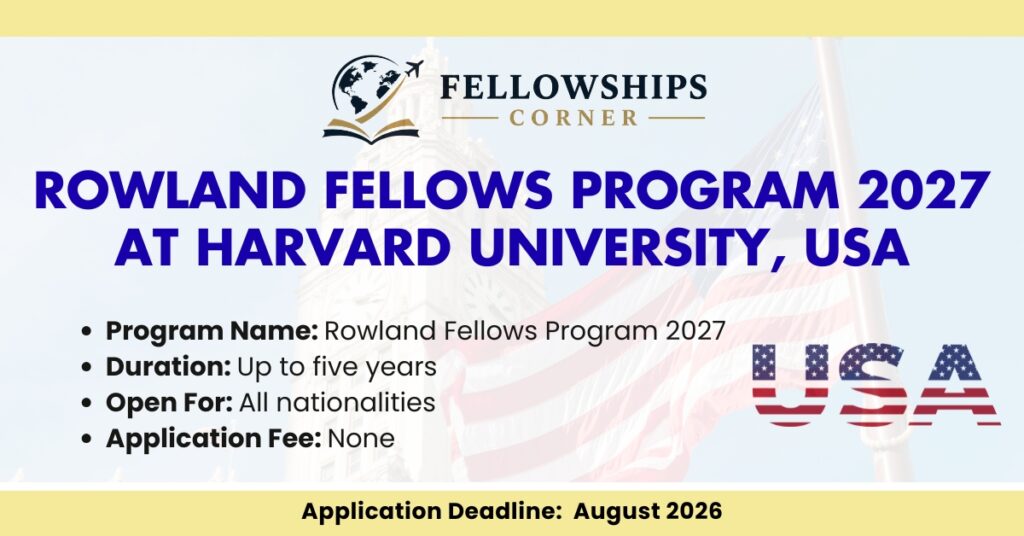
The fellowship duration is up to five years, with flexible start dates. For the 2027 cohort, start dates range from July to December 2027. This flexibility accommodates different graduation timelines and personal circumstances.
Also Check: AMBER Postdoctoral Fellowship
Check If you can Apply For this Program?
The program targets promising early-career researchers ready to transition to independence.
- Applicants must be completing their PhD or have received their PhD after May 1, 2025. You must finish your doctoral degree before the fellowship begins.
- Proposed research must be experimentally focused in any field of science or engineering, including physics, chemistry, biology, engineering, neuroscience, and related interdisciplinary areas.
- The program welcomes candidates from all accredited institutions worldwide, both in the United States and internationally.
- US citizens and non-US citizens are eligible. Harvard staff can assist with visa processes if needed.
- Human subjects or clinical research is not supported, as the institute emphasizes shared laboratory spaces across disciplines.
The breadth of fields is intentional. While past fellows’ work can inspire, the selection prioritizes the quality and potential impact of your proposed science. If your idea is novel, experimentally grounded, and high-risk/high-reward, it aligns well with the program’s mission.
Also Check: ICGEB Arturo Falaschi Fellowships 2026 across the Globe
How to Apply:
All applications must be submitted through the official Harvard Careers website. No other submission methods are accepted.
The process is designed to be straightforward but thorough. You can save your progress and return to the application multiple times before the deadline.
Required Application Materials:
- A 250-word “elevator pitch” that describes your research goals in accessible language for a general audience. This is your chance to convey excitement and broader impact.
- A Statement of Research (maximum three pages, including references). Detail your research proposal and, if relevant, summarize recent work that supports your plans.
- A full curriculum vitae (CV) highlighting your academic and research achievements.
- A Vision Statement (one page maximum). Explain how your personal values and academic experiences shape your approach to building a productive, supportive, and inclusive lab culture.
- Contact information for three or four references. The system will automatically send recommendation requests with clear deadlines.
Important Application Notes:
- You do not need to complete everything in one session. Log back in to make changes until you submit.
- Once submitted, you cannot revise materials. If you need to update before the deadline, email rf@g.harvard.edu to reactivate your account.
- Declare any use of AI tools in your application. Use them responsibly to support your thinking, not replace your unique voice and personal experiences. Admissions committees value authenticity and specific details that reflect your journey.
- Alert your references early so they have ample time to prepare strong letters.
Also Check: NAEd/Spencer Postdoctoral Fellowship in USA
Application Deadline and Timeline:
Deadline for 2027 Rowland Fellowships: Saturday, August 1, 2026, at 11:59 PM EDT.
Full Timeline:
- Applications due: August 1, 2026
- Letters of recommendation due: August 15, 2026
- September 2026: Notification to applicants who do not meet eligibility criteria.
- October 2026: First-round Zoom interviews for selected candidates; others notified.
- November 2026: Finalists invited for a two-day in-person interview at the institute.
- Day 1: Symposium with presentations on past and proposed research.
- Day 2: Interviews with current fellows, staff, and the admissions committee.
- December 2026: Final selection decisions announced.
Prepare your materials well in advance. Strong applications demonstrate not only scientific excellence but also clarity, creativity, and a vision for independent leadership.
Tips before Applying:
Craft your elevator pitch to engage non-specialists while highlighting innovation. Use the research statement to outline feasible yet ambitious experiments, supported by preliminary data where possible.
In your vision statement, be genuine. Discuss specific experiences that shaped your leadership style, perhaps mentoring undergraduates, overcoming research challenges, or fostering collaboration in diverse teams.
Choose references who know your work deeply and can speak to your potential as an independent researcher. Provide them with your proposal drafts early.
Review current and past fellows’ research on the Rowland website for inspiration, but ensure your proposal stands on its own originality.
Also Check: KWI International Fellowships 2027 in Germany
Life as a Rowland Fellow:
Fellows join a supportive community that values interaction across disciplines. You will have access to shared spaces that encourage spontaneous discussions and collaborations. Many fellows recruit team members, including postdocs and students, expanding their research impact.
The institute provides ongoing professional development. From budgeting workshops to leadership training, the support extends beyond the lab to prepare you for the next stage of your career—whether tenure-track positions, industry roles, or founding companies.
Recent examples include fellows exploring quantum materials, bio-inspired engineering, and advanced imaging techniques. Their work demonstrates the program’s commitment to cutting-edge experimental science.
Equal Employment Opportunity:
Harvard University is committed to equal opportunity and non-discrimination. The university seeks talent from all parts of society and strives to create an inclusive environment where everyone can thrive. Differences strengthen the community and advance Harvard’s mission. The equal employment opportunity policy prohibits discrimination based on race, sex, ethnicity, color, national origin, religion, disability, or any other protected characteristic.
Take the Next Step Toward Your Independent Research Career:
The Rowland Fellows Program represents a rare opportunity to establish your research vision with world-class support. With substantial funding, dedicated lab space, technical assistance, and a collaborative environment, selected fellows are positioned for transformative scientific contributions.
If you meet the eligibility criteria and have a compelling experimental research proposal, apply through the Harvard Careers portal before August 1, 2026. For questions about eligibility or the process, contact rf@g.harvard.edu.
This fellowship could be the launchpad for your most impactful work. Explore the official Rowland Institute website for the latest details and application link. Prepare thoughtfully, showcase your unique perspective, and take this exciting step toward scientific leadership.
Also Check: EMBO Postdoctoral Fellowships in Europe (Fully Funded)