
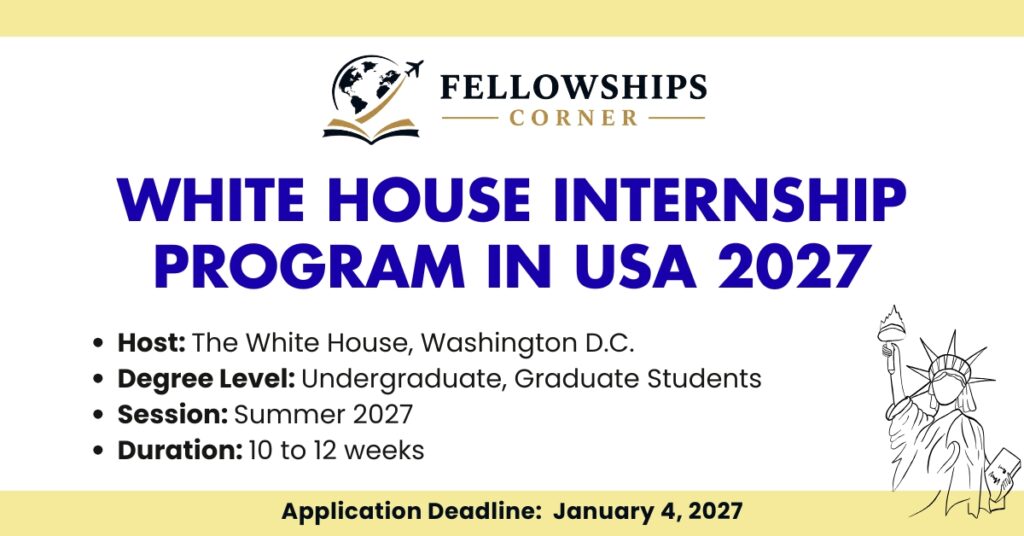
There are very few places on earth where a college student can spend a summer writing memos, staffing events, and sitting in on meetings inside the working offices of a head of state. The White House Internship Program is one of them. It is unpaid, it is demanding, and it is genuinely difficult to get into. It is also one of the most recognisable lines a young American can add to a résumé.
If you are considering applying for the Summer 2027 session, this guide walks you through the calendar, the honest realities, the eligibility rules, the offices you could be placed in, and the practical steps that separate a strong application from a forgettable one.
Put These Summer 2027 Dates in Your Calendar Right Now
The single most common reason capable applicants miss out is simple: they hear about the program after the portal has already closed. The window is short, and applications are reviewed on a rolling basis, which means late submissions face a smaller pool of remaining opportunity even if they arrive before the cutoff.
Here is the confirmed Summer 2027 timeline:
- Application posted: December 7, 2026
- Application deadline: January 4, 2027
- Acceptance notifications begin: February 15, 2027
- Internship start date: June 2, 2027
- Internship end date: August 6, 2027
Read that again and notice something important. The application opens in early December and closes on January 4. That entire window sits on top of final exams, winter break, and the holidays. Nobody is going to remind you. Set a phone reminder for late November 2026 so you can start gathering documents and contacting recommenders before the portal even goes live.
Also note the rolling review. Submitting on December 12 is meaningfully better than submitting on January 3. Do not save it for the last night.
The Honest Realities Most Applicants Discover Too Late
Before you invest hours in essays and recommendation letters, you deserve a clear picture of what this internship actually asks of you. These are not deal breakers for everyone, but they are deal breakers for some, and it is better to know now.
It is unpaid. White House internships carry no stipend and no salary. Applicants are encouraged to approach their own universities, foundations, and nonprofit organisations for funding support. Any outside income, funding, or housing assistance you receive while serving as an intern must be approved in advance.
There is no housing provided. The program does not arrange or subsidise accommodation. You are responsible for finding and paying for your own place to live in Washington, D.C., which is not an inexpensive city.
It is in person and full time. Remote participation is not an option. Interns are expected to be on site Monday through Friday, roughly 9:00 a.m. to 6:00 p.m. Limited flexibility exists for genuine class or program requirements, but you must still work at least 4.5 days per week to count as a full time intern. In practice, that might mean leaving at 1:00 p.m. or later on one day of the week.
You will be screened. Every selected applicant must complete and pass drug testing and a security screening. This is standard for anyone working inside the White House Complex.
Taken together, these four points mean the real cost of a White House internship is roughly one summer of lost earnings plus living expenses in D.C. Plan your finances early, and start the conversation with your university’s financial aid or career services office well before the deadline. Many institutions have dedicated funds for unpaid public service internships, but those funds have their own deadlines.
Also Check: HENNGE Global Internship Program 2026 in Japan
Who Can Actually Apply
Eligibility works in two layers. You must satisfy every item in the first layer, and at least one item in the second.
Layer one: general requirements for everyone
- You must be a United States citizen
- You must be at least 18 years of age
- You must complete and pass drug testing and security screening
- You must agree to full time, in person work
Layer two: your academic or service status
You need to meet at least one of the following:
- You are currently enrolled in an undergraduate or graduate degree program at a college, community college, or university (a two year or four year institution) and will have completed two semesters before the internship start date
- You graduated from an undergraduate or graduate degree program at a college, community college, or university (a two year or four year institution) no more than two years before the internship start date
- You are a veteran of the United States Armed Forces who holds a high school diploma or its equivalent and served on active duty, for any length of time, during the two years preceding the internship start date
That third pathway matters and it is often overlooked. Recent veterans do not need a college degree to be eligible. If you served on active duty within the qualifying window and hold a high school diploma or equivalent, you can apply on the strength of that service alone.
Community college students should also note that they are explicitly included. This is not a program restricted to students at four year universities.
What the Selection Committee Is Looking For
Selection is based on three stated criteria:
- A demonstrated commitment to public service
- Demonstrated leadership within your community
- A commitment to the mission of the Trump Administration
The program states that political party preference is not a deciding factor in the application review. What is described as essential is that applicants are dedicated to the ideals and mission of the White House.
In practical terms, this tells you what your written application should emphasise. Volunteer work, campus organising, military service, local government involvement, faith community leadership, and any sustained effort where you took responsibility for something larger than yourself will carry more weight than a list of academic honours. Depth beats breadth. One three year commitment where you clearly grew into a leadership role reads better than eight loosely connected activities.
Also Check: The World Bank Group Pioneers Internship Program 2026
Where Interns Are Actually Placed
Interns support both Presidential and Vice Presidential offices, and the placement you receive shapes your entire experience. Knowing the landscape helps you write an application that speaks to a specific office rather than a generic one.
Policy focused offices
- Domestic Policy Council: develops, coordinates, and executes domestic policy. Interns work on areas such as education, energy and the environment, healthcare, immigration, infrastructure, labour, transportation, urban affairs, and veterans’ affairs, and may support speechwriting research and fact checking
- National Economic Council: coordinates domestic and international economic policymaking. Portfolio includes healthcare, tax and retirement, the financial system, macroeconomics, infrastructure, agriculture, technology, telecommunications, cybersecurity, energy, and trade
- Office of Trade and Manufacturing Policy: advises on economic growth, the trade deficit, and strengthening American manufacturing and the defence industrial base
- National Energy Dominance Council: supports domestic energy projects and policies aimed at increasing domestic energy production
- The White House Faith Office: partners with faith based entities, community organisations, and houses of worship on initiatives including religious liberty and strengthening families
Communications and media offices
- Office of Communications: plans core messaging initiatives across research, broadcast, and digital
- The White House Press Office: works with media from around the world across national press, communications, and messaging. Expect an environment driven by the around the clock news cycle
- Office of Digital Strategy: digital content creation, design, and online engagement
- Office of Speechwriting: research and support for the President’s speeches
- White House Photo Office: photo editing and toning, database maintenance, and logistics. Proficiency in Adobe Creative Suite and macOS is required for this office
Operations, legal, and outreach offices
- Office of Legislative Affairs: supports the Senate and House liaison teams, legislative research, and legislative events
- Office of Cabinet Affairs: the primary link between the President and the Cabinet
- Office of Intergovernmental Affairs: relationships with governors, tribal leaders, mayors, county executives, and commissioners
- Office of Public Liaison: the main communication line between the White House and the public
- Office of Political Affairs: political analysis, opinion research, and constituency outreach
- Office of Presidential Advance: planning and executing presidential events domestically and abroad
- Office of Presidential Correspondence: letters, emails, comment line calls, proclamations, greetings, and requests for assistance
- Office of Presidential Personnel: supports the selection and clearance process for presidential appointments
- Office of the Staff Secretary: prepares the daily briefing book and vets material going to the President. Strong attention to detail and editing skill required
- Office of Presidential Scheduling: manages the President’s meetings and daily agenda
- Office of White House Counsel: legal research and administrative support at the intersection of law, policy, and politics
- White House Management Office: facilities, operations, staff privileges, and Complex access
- White House Visitors Office: tours, seasonal events, South Lawn events, and garden tours
- White House Travel Office: travel budgets, accommodation, transportation, per diems, passports, visas, and press corps logistics
- Office of the First Lady: supports the First Lady’s initiatives inside the Complex and across the country
Office of the Vice President
The Office of the Vice President supports Vice President J.D. Vance and Second Lady Usha Vance. Internship opportunities exist within:
- Office of the Second Lady
- Office of Administration
- Office of Advance for the Vice President
- Office of Communications
- Office of Counsel to the Vice President
- Office of Intergovernmental Affairs
- Office of Domestic Policy
- Office of Correspondence
The Office of the Second Lady in particular involves event preparation, policy related projects, outreach, and daily operations supporting her initiatives.
Also Check: Procter & Gamble (P&G) Paid Internship Program 2026
What a Typical Day Looks Like
Assignments vary widely by office, but on any given day an intern might be conducting research, managing incoming inquiries, attending meetings, writing memos, or staffing events. Nobody spends ten weeks doing only one thing.
Regardless of placement, all interns are brought together through weekly programming that includes a speaker series and professional development sessions. Community is a deliberate part of the design, and interns are given opportunities to take part in volunteer projects. Each session runs 10 to 12 weeks, with Spring, Summer, and Fall cycles offered on a continuous basis.
How to Apply Without Sabotaging Yourself
Applications are accepted only through the official online portal at intern.whitehouse.gov/whip. Hard copies mailed to the White House will not be reviewed. There is no alternative submission route.
Your recommendation letters deserve special attention because they are where most applications quietly fall apart.
- Letters can be written by anyone who can genuinely speak to your qualifications, character, and commitment to public service. That includes professors, supervisors, commanding officers, coaches, and community leaders
- Address letters to the White House Internship Program where possible
- Letters must be uploaded through the application portal as a PDF to count as part of your package
- Late letters carry a penalty. Every element of the application, recommendations included, must arrive on or before the deadline
Here is the part that trips people up. Your recommenders are on holiday break during exactly the window when these letters are due. Ask them in November 2026, give them your résumé and a short note on why you are applying, and follow up politely in mid December. Do not assume a professor will check email on December 30.
A quick safety note: the only legitimate application route is the official portal linked above. The White House Internship Program does not charge an application fee, and it does not recruit through social media agents, WhatsApp groups, or third party consultants promising placement. Any website or individual asking you to pay for a White House internship application is running a scam. Verify every link before entering personal information.
How to Make Your Application Stand Out
- Be specific about one office. A candidate who explains why the Office of Presidential Correspondence fits their experience with constituent casework is more memorable than one who says they would be happy anywhere
- Show sustained commitment, not scattered involvement. Selection criteria explicitly reference commitment and demonstrated leadership. Both words imply time
- Write in your own voice. Applications that sound generated or heavily templated do not read as authentic, and authenticity is exactly what a character based selection process is trying to assess
- Sort your finances before you apply, not after you are accepted. Reach out to your university’s career centre and any external funders in the autumn
- Apply early in the window. Rolling review rewards it
- Proofread ruthlessly. Several offices, particularly the Staff Secretary and Speechwriting, list attention to detail as a core requirement. A typo in your application undercuts that claim before anyone reads a word of your essay
Frequently Asked Questions?
Is the White House Internship Program paid?
No. White House internships are unpaid. Applicants are encouraged to seek support from their educational institutions and other nonprofit organisations. Any outside income, funding, or housing assistance received while serving as an intern must receive prior approval.
Can international students apply?
No. Applicants must be United States citizens. There is no exception to this requirement, and it is one of the first eligibility filters applied.
Does the program provide housing in Washington, D.C.?
No. Interns must arrange and pay for their own accommodation. Begin your housing search well before the internship start date, since summer demand in D.C. is high.
What are the working hours?
Expect Monday through Friday, roughly 9:00 a.m. to 6:00 p.m. Limited exceptions are made for class or program requirements, but interns must work at least 4.5 days per week to be considered full time. For example, an intern might leave at 1:00 p.m. or later on one day of the week.
Does my political affiliation affect my chances?
The program states that political preference is not a deciding factor in the application review. What is described as essential is a commitment to the ideals and mission of the White House, and a commitment to the mission of the Trump Administration is listed among the selection criteria.
Can I mail a printed application?
No. Hard copies are not accepted under any circumstances. Only applications submitted through the official online portal are reviewed.
Who should write my recommendation letters?
Anyone who can credibly speak to your qualifications, character, and commitment to public service. Choose people who know your work well over people with impressive titles who barely know you. Letters should be addressed to the White House Internship Program where possible and must be submitted through the portal as a PDF.
What happens if my recommendation letter arrives late?
Late materials count against you. All application components, including recommendation letters, must be submitted on or before the deadline. Because applications are reviewed on a rolling basis, submitting your complete package early is strongly advised.
Can recent graduates apply?
Yes. If you completed an undergraduate or graduate degree at a college, community college, or university no more than two years before the internship start date, you are eligible.
Do veterans need a college degree to apply?
No. Veterans of the United States Armed Forces who hold a high school diploma or its equivalent and served on active duty, for any length of time, in the two years preceding the internship start date are eligible.
How long does the internship last?
Sessions run 10 to 12 weeks. The Summer 2027 session runs from June 2, 2027 to August 6, 2027.
Are there other sessions besides summer?
Yes. The program operates on a continuous basis with Spring, Summer, and Fall sessions. If the Summer 2027 timeline does not fit your academic calendar, watch for the announcements covering other cycles.
The White House Internship Program exists to make the People’s House accessible to future leaders from across the country, and it is built around leadership development, professional experience, and community impact. It will not pay you, it will not house you, and it will ask for your full working week for roughly three months. In exchange, you get proximity to how the executive branch actually functions, a cohort of peers from every corner of the country, and a credential that opens doors for decades.
Your next step is small and concrete. Set a calendar reminder for late November 2026. Use it to draft your application materials and to ask two people for recommendation letters before the winter break scatters everyone. When the portal opens on December 7, 2026, you want to be submitting, not starting.