If you are a doctoral candidate or an early career postdoc researching how digital technology is reshaping society, this fellowship deserves a spot on your calendar. Before you start drafting an application though, there is one thing you absolutely need to understand, because it is the reason a large number of applications get rejected before a jury even looks at the research quality.
The Mistake That Gets Applications Rejected Before They Are Even Read
Many applicants assume “Digital Humanism” is just another way of saying “Digital Humanities.” It is not, and the Institute for Human Sciences (IWM) in Vienna is explicit about this.
Digital Humanism is not about using digital tools to study literature, history, or art. It is about examining, questioning and shaping the relationship between technology and humankind, with the goal of building a better, more humane society while protecting universal human rights. Think of it as sitting at the intersection of computer science, political science, economics, law, sociology and philosophy, not as a technique borrowed for traditional humanities research.
So before you apply, ask yourself honestly: is my project about the societal, economic, political or ethical impact of digitalization? Or am I simply applying digital methods to a humanities topic? If it is the second one, this call is not for you, and the selection committee will screen it out.
What This Fellowship Actually Offers
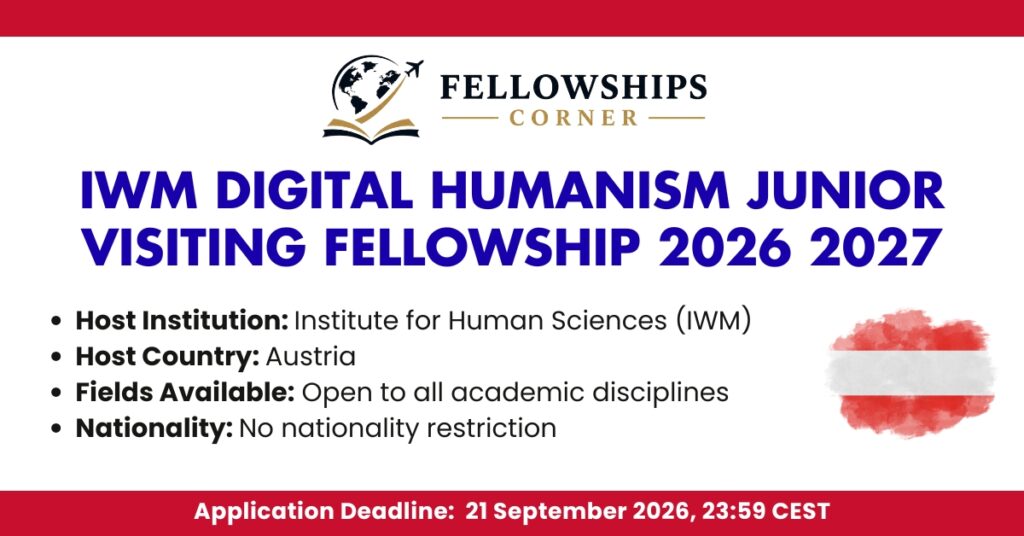
The Digital Humanism Junior Visiting Fellowship is part of the wider Digital Humanism Program at IWM in Vienna. It is open to every academic discipline, as long as the research fits the definition above.
Selected fellows are invited to spend three consecutive months in residence at IWM Vienna, sometime between February and June 2027. The exact timing is arranged so that your stay overlaps with the presence of the Senior Digital Humanism Visiting Fellow for that cycle, which means you will be working alongside a more experienced researcher in the same field, not researching in isolation.
During your stay, IWM covers the essentials so you can focus on your work:
- A dedicated office space
- Internet access
- In house research facilities
- Administrative support, all free of charge
- Full access to the IWM community of scholars and its regular seminars, talks and events
Your fellowship period runs from the first day of your starting month through the last day of your final month, so plan your travel and any teaching or work commitments back home around that full three month block.
Also Check: Deakin University Postgraduate Research Scholarship (DUPR)
Who Can Apply
Eligibility is fairly specific, so check each point carefully before you invest time in a full application.
- You must currently be enrolled in a doctoral program, or have obtained your PhD no earlier than four years before the application deadline. In practice, this means your PhD defense must have taken place on or after 21 September 2022.
- You cannot submit more than one fellowship application to IWM within the same academic year.
- If you have previously held an IWM fellowship, you need to wait three full academic years before you are eligible to apply again.
There is no restriction based on nationality, discipline, or institution, provided your research topic genuinely fits the Digital Humanism focus described above.
Also Check: Rowland Fellows Program 2027 at Harvard University, United States
The Stipend and What You Are Expected to Cover
IWM pays a monthly stipend for the full three month term, and the amount depends on where you are in your academic career at the time of the application deadline.
- Researchers who have already defended their PhD receive EUR 3,300 per month.
- Researchers still pursuing their doctoral degree receive EUR 2,750 per month.
This stipend is meant to cover your entire cost of living in Vienna. That includes your flight or train travel to and from the city, accommodation, health insurance, utilities, local transport, phone and internet bills, and any research related costs such as books, journal access, or conference registration fees. Vienna is not an inexpensive city, so it is worth budgeting realistically rather than assuming the stipend will stretch as far as it might elsewhere.
Also Check: Institut Courtois Postdoctoral Fellowship 2026 in Canada
How to Apply, Step by Step
Applications are accepted only through the official online application form. IWM will not review or accept anything sent by email, so do not attempt to shortcut the process by contacting the program directly with your documents.
Here is what you need to prepare before you start the online form:
- A letter of motivation explaining why your project needs time at IWM specifically, how it connects to IWM’s mission and existing research strands, and what concrete research or writing goals you plan to achieve during your three months there.
- A project description of no more than 550 characters, including spaces. That is roughly the length of a strong paragraph, so every word needs to earn its place.
- A full project proposal of no more than 7,500 characters including spaces, structured around four elements: your project’s objectives, a discussion of the current state of research in your area, your methodology, and a concrete work plan for the fellowship period.
- A curriculum vitae that includes a full list of your publications.
- Two letters of recommendation from scholars who know your academic work well.
One detail that trips a lot of applicants up: all of your documents (motivation letter, project description, proposal, and CV) must be combined into a single PDF file, because the online form only allows one attachment. Also make sure every file name uses standard Latin characters only, since special characters or non Latin script in a file name can cause upload issues.
Your recommenders do not send their letters to you or attach them to your application. Once you submit your form, they will automatically receive an email containing a link to a separate web form where they submit their letter directly. Make sure you contact your recommenders well in advance and confirm they are comfortable with this process, since both letters must arrive before the deadline for your application to be considered complete.
Also Check: AMBER Postdoctoral Fellowship
Key Dates to Put on Your Calendar
- Application deadline: 21 September 2026, 23:59 CEST
- Decision notifications: by 30 November 2026, sent by email
- Fellowship term: three consecutive months, scheduled between February and June 2027
Keep in mind the jury is under no obligation to explain its decision or give individual feedback, whether your application is accepted or not, so do not expect detailed reasoning either way.
Also Check: ICGEB Arturo Falaschi Fellowships 2026 across the Globe
A Few Tips Before You Submit
Since character limits are strict, draft your project description and proposal in a separate document first, then trim it down rather than trying to write directly within the limit. Read the 550 character description out loud. If it sounds like a vague summary rather than a sharp pitch, rewrite it.
Also, be explicit in your motivation letter about why IWM, and not another institute, is the right place for this specific project. Reviewers can tell the difference between a generic fellowship letter recycled across multiple applications and one that genuinely engages with IWM’s Digital Humanism Program.
Finally, double check your PhD defense date against the 21 September 2022 cutoff well before the deadline. This is an easy detail to get wrong under time pressure, and it is a hard eligibility line, not a guideline.
Also Check: NAEd/Spencer Postdoctoral Fellowship in USA
Frequently Asked Questions
Is this the same as a Digital Humanities fellowship?
No. Digital Humanism looks at how digitalization affects society, economics, politics, and human rights. Digital Humanities is about applying digital tools and methods to traditional humanities research. IWM explicitly states that applications which simply use digital methods to study humanities topics will not be considered under this call.
Can PhD students apply, or is this only for postdocs?
Both can apply. Current doctoral students receive EUR 2,750 per month, while those who have already defended their PhD (within the last four years, meaning on or after 21 September 2022) receive EUR 3,300 per month.
Do I need to be affiliated with an Austrian university to apply?
No. The fellowship is open internationally to researchers from any country and any academic discipline, as long as the research project fits the Digital Humanism focus area.
What if I already held an IWM fellowship in the past?
You are still eligible, but only after a gap of three full academic years since your previous IWM fellowship. If that waiting period has not passed yet, you will need to apply in a future cycle.
Can I submit my documents by email if I am having trouble with the online form?
No. IWM only accepts applications through the online application form. Applications sent by email will not be reviewed, so it is worth testing the form and gathering your documents well ahead of the deadline in case of technical issues.
When will I find out if I was selected?
All applicants are notified of the jury’s decision by email no later than 30 November 2026.
Do both recommendation letters need to arrive before the deadline?
Yes. Your recommenders will receive an automated email with a link to submit their letter only after you complete your own application, so reach out to them early and make sure they understand the deadline applies to them too.
This is a genuinely well supported fellowship, three months in Vienna, a monthly stipend, office space, and a built in research community, but it is also narrowly defined. Read the Digital Humanism focus area twice before you commit time to an application, confirm your PhD timeline against the cutoff date, and start gathering your recommendation letters early. If your project fits, head to the official IWM application page and submit before 21 September 2026, 23:59 CEST.