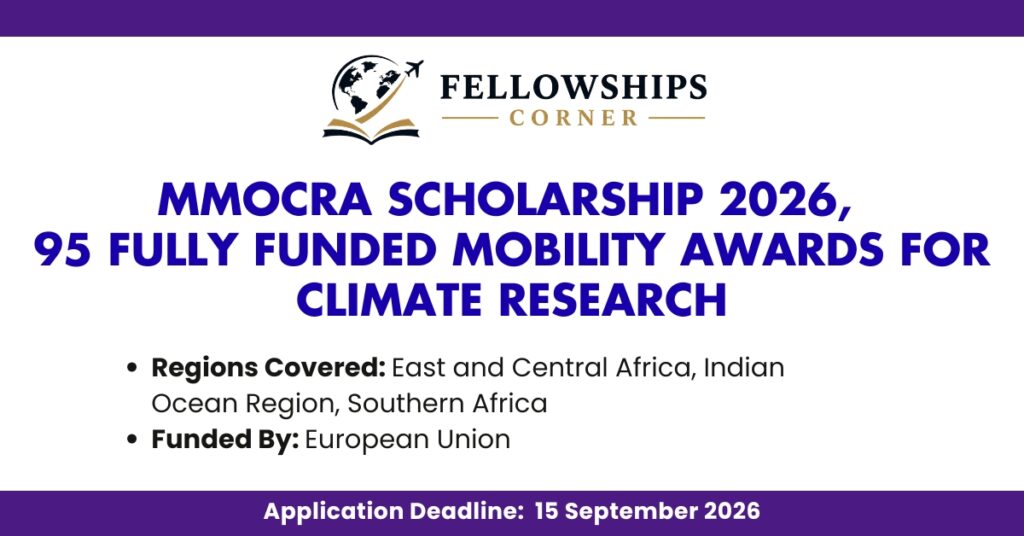
Ninety five fully funded places. One deadline. A chance to study, teach, or train at some of Africa’s and Europe’s leading universities while working on real climate solutions. That is the offer sitting behind MMoCRA, and if you have been searching for a fully funded scholarship that combines climate work with genuine academic mobility across Africa, this is worth a close look before the window closes.
MMoCRA stands for Multidisciplinary Mobility for a Climate Resilient Africa. It is funded by the European Union through the Intra Africa Academic Mobility Scheme, and it links top African universities with a European partner to train a new generation of scientists, engineers, and practitioners who can tackle climate challenges across the continent. Applications for the current cycle close on 15 September 2026, so anyone considering it should start preparing now rather than in the final week.
How Many Scholarships Are Available and What They Cover
MMoCRA is offering 95 fully funded mobility places in this round, split across four categories. Knowing where you fit matters, because the length of funding, the type of support, and the application expectations differ for each group.
- 44 Master’s scholarships, funded for up to 24 months
- 12 Doctoral scholarships, funded for up to 36 months
- 20 short term traineeships, lasting 3 to 6 months
- 19 staff mobility placements, lasting 1 to 3 months
For students, the funding is described as a full scholarship, meaning it is built to cover tuition fees, a living stipend, and travel costs rather than just a partial contribution. That matters a great deal for anyone worried about affording an international move on top of tuition. Staff mobility awards work differently since they are shorter placements aimed at teaching collaboration and institutional capacity building rather than degree study, but they still come with funded travel and stay.
Who This Program Is Actually For
One thing that trips people up with mobility schemes like this is assuming they are only for students. MMoCRA is deliberately broader than that, and understanding the different tracks helps you figure out where you belong.
Students and early career researchers are the largest group and the main beneficiaries. If you are a Master’s student, a doctoral candidate, or looking for a short traineeship, this is your entry point. The program is built to give you access to world class facilities, multidisciplinary training, and the kind of scientific and technical skills that are genuinely useful for climate work in Africa, not just for academic credentials on paper.
Academic and administrative staff including lecturers, researchers, supervisors, and mobility coordinators can apply for shorter placements focused on teaching, research collaboration, and strengthening their home institution’s capacity.
Industry professionals working in energy, agribusiness, sustainability consultancies, or research and innovation hubs are also part of the wider MMoCRA ecosystem, with opportunities for collaboration and knowledge exchange, though the structured scholarship tracks above are the main funded pathways for individuals.
Beyond these groups, MMoCRA is also meant to feed into policy conversations and community level impact, so government agencies, regional policy bodies, and civil society organizations engaging with climate resilience work may find value in the program’s outputs even if they are not applying for a mobility place themselves.
Also Check: Chevening Scholarship 2026/2027
The Universities Behind MMoCRA
Part of what makes this scheme attractive is the caliber and spread of the partner institutions involved. You are not applying to one university, you are applying into a network, and where you end up depends on your research theme.
- Busitema University, Uganda
- Kyambogo University, Uganda
- Strathmore University, Kenya
- University of Cape Town, South Africa
- Namibia University of Science and Technology, Namibia
- University of Twente, the Netherlands
Each institution leads specific research themes, which is worth paying attention to when you decide what to apply for, since your proposed research area often determines which university you would be placed with.
Also Check: iwm Digital Humanism Junior Visiting Fellowship 2026 2027
The Two Research Themes You Can Work Within
MMoCRA organizes its research and training around two connected fields, both aimed at building climate resilience in practical, applied ways rather than purely theoretical study.
Climate and Energy
This theme deals with sustainable energy and environmental protection as climate pressures intensify. Key areas include:
- Green energy production and distribution, including renewable technologies and clean energy access
- Environmental sustainability and climate mitigation strategies
- Water and air pollution management, covering monitoring and remediation
- Biodiversity conservation and ecosystem protection
- Sustainable management of critical raw materials
Strathmore University leads on green energy, the University of Cape Town leads on environmental sustainability and pollution management, Namibia University of Science and Technology leads on biodiversity conservation, and Busitema University leads on sustainable raw materials.
Agrifood Systems
This theme focuses on adapting food and farming systems to a changing climate while protecting food security. Key areas include:
- Climate smart agriculture and adaptive farming techniques
- Sustainable crop production, with particular attention to cocoa and coffee value chains
- Food security and nutrition across African communities
- Land degradation mitigation and soil restoration
- Agricultural innovation blending technology with traditional farming knowledge
Busitema University leads on agrifood systems and cocoa and coffee value chains specifically, while Kyambogo University leads on crop production for climate resilience.
Running through both themes are cross cutting priorities the program pays close attention to: digital technologies and innovation, gender equality and social inclusion, and genuine multidisciplinary collaboration rather than siloed research.
Also Check: Deakin University Postgraduate Research Scholarship (DUPR)
Where the Program Operates
MMoCRA’s reach spans three regional clusters across Africa:
- East and Central Africa
- Indian Ocean Region
- Southern Africa
If your home institution or research interest falls within these regions, you are within the program’s intended coverage area.
Application Deadline and What Happens Next
The deadline for this cycle is 15 September 2026. With 95 places spread across a well known, EU backed program, competition is likely to be significant, so leaving your application until the final days is a real risk. Strong applications, especially for Master’s and Doctoral tracks, typically take weeks to prepare properly once you account for reference letters, transcripts, and a well written research or study proposal.
Since exact document checklists and portal instructions can be updated by the consortium, always confirm the full eligibility criteria and required documents on the official MMoCRA website before submitting anything. Do not rely on secondhand summaries, including this one, for final procedural details.

Why This Opportunity Is Worth Prioritizing
A few things make MMoCRA stand out from the usual scholarship listings you might come across.
First, it is fully funded, not partially funded, for the student tracks, which removes one of the biggest barriers to international study: cost. Second, it connects you to a genuine multi country network rather than a single university, which matters a lot if you plan to build a career in climate research or policy across Africa. Third, the research themes are applied and practical, covering energy, agriculture, water, and biodiversity rather than abstract academic exercises, which tends to make graduates more employable in both public and private sector climate roles afterward.
If you are preparing an application, it helps to be specific rather than generic. Tie your proposed research clearly to one of the lead institutions’ focus areas, reference real challenges relevant to your home region, and be honest about what mobility would let you achieve that staying at your current institution would not.
Also Check: Lester B. Pearson International Scholarship for Bs in canada
Frequently Asked Questions
What is the MMoCRA scholarship?
MMoCRA, short for Multidisciplinary Mobility for a Climate Resilient Africa, is an EU funded academic mobility program under the Intra Africa Academic Mobility Scheme. It funds Master’s, Doctoral, traineeship, and staff mobility placements across a network of African and European universities focused on climate resilience research.
How many scholarships are available in this round?
There are 95 mobility places available in total: 44 Master’s scholarships, 12 Doctoral scholarships, 20 short term traineeships, and 19 staff mobility placements.
What does the scholarship cover?
The student scholarships are described as fully funded, covering tuition fees, a living stipend, and travel costs. Staff mobility placements cover funded travel and stay for the shorter placement period.
Who can apply for MMoCRA?
The program is aimed at Master’s students, doctoral candidates, individuals seeking short term traineeships, and academic or administrative staff such as lecturers, researchers, and mobility coordinators connected to the consortium’s network and focus regions.
Which universities are part of the MMoCRA network?
The partner institutions are Busitema University and Kyambogo University in Uganda, Strathmore University in Kenya, the University of Cape Town in South Africa, Namibia University of Science and Technology, and the University of Twente in the Netherlands.
What subjects or research areas does MMoCRA fund?
Research falls under two broad themes: Climate and Energy, which covers green energy, environmental sustainability, pollution management, biodiversity conservation, and raw materials, and Agrifood Systems, which covers climate smart agriculture, crop production, food security, and land degradation.
When is the application deadline?
The deadline for this cycle is 15 September 2026.
Where can I find the official application details?
Full eligibility requirements, required documents, and the application portal are available on the official MMoCRA website. Always verify current instructions there rather than relying solely on secondary sources.
MMoCRA is one of the more substantial climate focused mobility programs currently open to applicants connected to African universities, backed by EU funding and a genuinely multi country network of institutions. With 95 places on offer and a firm deadline of 15 September 2026, the practical next step is simple: identify which track fits you, whether Master’s, Doctoral, traineeship, or staff mobility, match your interest to the right lead institution’s research theme, and head to the official MMoCRA website to confirm exact eligibility criteria and begin your application well before the deadline.