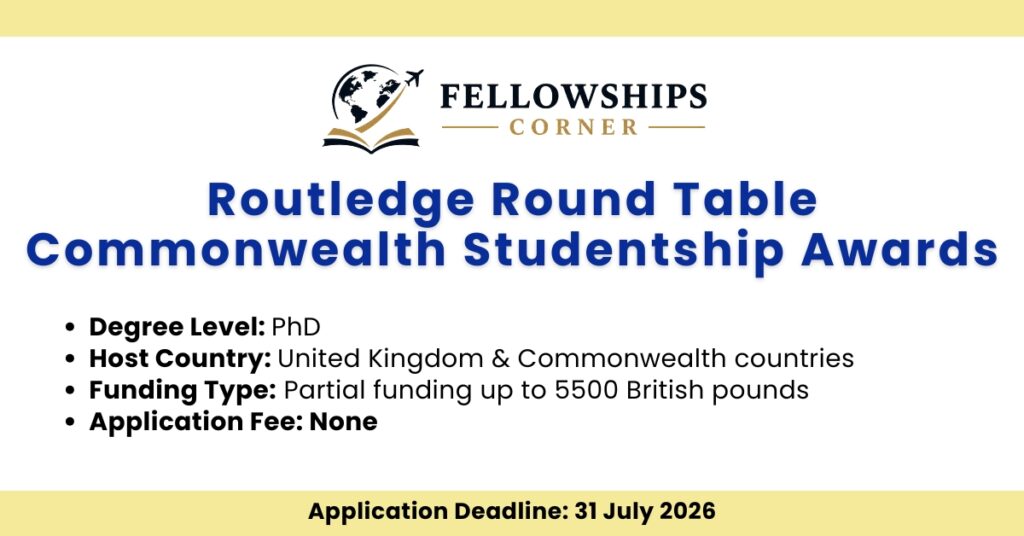
If you are a PhD student with an interest in Commonwealth affairs, international relations, or comparative policy research, the Routledge/Round Table Commonwealth Studentship Awards could be exactly the kind of funding opportunity you have been looking for. This annual award is not just a cash grant. It is built around mentorship, publication, and the chance to bring a genuinely international dimension to your doctoral research.
In this guide, we break down everything you need to know about the studentship, including who can apply, what counts as eligible research, how the mentorship component works, and how to submit your application before the deadline.
What Are the Routledge/Round Table Commonwealth Studentships?
The Routledge/Round Table Commonwealth Studentships are PhD funding awards designed to support research projects connected to Commonwealth-related themes. The studentships are jointly funded by The Round Table: The Commonwealth Journal of International Affairs, its publisher Routledge, and the Association of Commonwealth Universities (ACU).
Each year, two studentships are awarded, each worth up to £5,500 GBP:
- One studentship for a student registered at a UK university
- One studentship for a student registered at a university in another Commonwealth country
This dual structure means the programme is genuinely international in scope, supporting one researcher based in the UK and one based elsewhere in the Commonwealth each award cycle.
Who Can Apply
Eligibility for the two studentships works slightly differently depending on where you are registered as a PhD student.
The UK studentship is open to any registered PhD student at a UK university. You do not need to hold UK citizenship to apply. What matters is that your PhD registration is with a UK institution.
The second studentship is open more broadly. You are eligible if either of the following applies to you:
- You are a registered PhD student at a university that is a member of the ACU, located in a Commonwealth country other than the UK
- You are an alumnus of the Chevening Scholarship or the Commonwealth Scholarship programme, and you are currently a PhD student at any Commonwealth university located outside the UK
If you are unsure whether your university is an ACU member, it is worth checking the ACU’s list of member institutions before you apply, since this determines your eligibility for the non-UK studentship.
Which Academic Disciplines Are Eligible
The studentships welcome applications from a wide range of disciplines across the humanities and social sciences. That said, preference may be given to subject areas that align closely with the focus of the Round Table journal itself. These priority areas include, but are not limited to:
- Politics
- International relations
- Economics
- International history
- Geography
- Law
- Development studies
- Area studies
It is worth noting what is explicitly excluded. Applications from the pure sciences and medicine will not be considered. However, this does not mean health-related research is entirely off the table. Studies that focus on science policy or health policy, rather than the science or medicine itself, are welcomed. So a PhD student researching the politics of vaccine distribution across Commonwealth countries, for example, would likely be a stronger fit than one conducting laboratory-based medical research.
What Counts as Commonwealth-Related Research
This is probably the most important eligibility criterion to understand properly, because it determines whether your specific research topic qualifies at all.
Your proposed research must meet at least one of the following conditions:
- It relates to the Commonwealth as a whole, or to a Commonwealth-wide institution or organisation
- It has a comparative aspect across Commonwealth countries
- It is relevant to more than one Commonwealth country
The guidance includes some genuinely useful examples to help clarify what this means in practice. A research project comparing LGBT rights in South Africa and Uganda would be eligible, since it involves a direct comparison between two Commonwealth nations. A project examining the reform of colonial-era anti-LGBT legislation in India would also qualify, because it engages with a Commonwealth-wide historical and legal legacy rather than a single country in isolation.
On the other hand, a project focused solely on the role of a single advocacy organisation, such as Stonewall, in the UK alone would not be eligible, since it lacks any comparative or cross-Commonwealth element. Similarly, a project studying media bias or election law in Canada on its own would not qualify. However, the moment you introduce a comparative dimension, such as comparing Canada with Jamaica or Australia, the same broad topic becomes eligible.
This is an important point for prospective applicants: your current PhD topic does not need to already have a Commonwealth focus. In fact, the programme explicitly welcomes applications where the studentship would allow the applicant to add a Commonwealth dimension to research that did not originally have one. If you are working on a topic that could plausibly be extended to a comparative or cross-national Commonwealth angle, this scholarship gives you the funding and structure to make that happen.

The Mentorship Requirement
Unlike many PhD funding schemes that simply hand over money, this studentship places real emphasis on mentorship as a core part of the experience.
As a condition of the award, applicants are required to identify and work with a mentor based at a university in a Commonwealth country different from the one where the applicant is based. The mentor should be someone with relevant expertise in a subject connected to the applicant’s research, capable of offering meaningful guidance and support throughout the studentship period.
Before submitting an application, candidates are encouraged to informally reach out to at least one potential mentor. This is a sensible step to take early, since if your application is successful, you will then be required to secure a formal letter of support from that mentor confirming their agreement to take on the role. Your studentship will not be confirmed until this letter is in place, so lining up a willing mentor in advance can save you time and stress later in the process.
What the Mentor Is Expected to Do
The mentor’s role is reasonably structured and goes beyond a casual advisory relationship. Mentors are expected to:
- Hold a minimum of two virtual meetings with the student over the course of the studentship
- Maintain regular email contact, sharing their own experience in the relevant field
- Offer advice on publishing opportunities, relevant events, and emerging trends in the field
- Challenge and encourage the student to think about their research in new ways
- Contribute to either the final podcast or the final article the student is required to produce
In recognition of this commitment, mentors receive an honorarium of £500 GBP, paid at the end of the studentship period. Mentors are also required to read and follow the programme’s mentor code of conduct guidelines, which sets expectations for professionalism and the nature of the mentoring relationship.
If you are applying, it is worth thinking carefully about who would make a strong mentor for your specific project. Ideally, this is someone whose expertise complements your own research gaps, particularly around the Commonwealth or comparative angle you are developing, rather than simply someone in your existing academic network.
What You Are Required to Produce After the Studentship
The award does not end once the funding is received. Successful applicants take on two concrete deliverables following the completion of their studentship.
First, within twelve months of taking up the award, you are required to submit an article based on your research for consideration in the Round Table journal. This article should be between 4,000 and 6,000 words. This is a meaningful opportunity in its own right, since it gives you a route to a relevant academic publication tied directly to funded research, with built-in editorial engagement from a recognised journal in the field.
Second, you are required to produce a podcast based on your research, which will be published on the journal’s website. This is a slightly less traditional output than most academic funding schemes ask for, and it offers a chance to communicate your work to a broader audience beyond strictly academic readers. Given that your mentor is also expected to contribute to either the article or the podcast, this final stage of the studentship is genuinely collaborative rather than something you complete alone.
If you are not particularly experienced with podcasting or public-facing science communication, it may be worth starting to think early about how you would approach this requirement, since it is just as much a condition of the award as the article.
How and When the Award Is Paid
The studentship is paid in two installments rather than as a single lump sum. £4,000 GBP is paid out upon the announcement of the awards. The remaining £1,500 GBP is paid later, once you have completed the post-studentship requirements, meaning the submission of your article and your podcast.
This structure is worth keeping in mind when you plan your budget around the award, since the final portion of the funding is contingent on completing both deliverables rather than being guaranteed upfront.
Application Deadlines and Key Dates
For the current funding round, the dates to keep in mind are as follows:
- Applications for the 2026–27 awards are open now
- The closing date for applications is 31 July 2026
- Winners are expected to be announced in September 2026
Given that the application process includes informally approaching a potential mentor before submission, it is worth starting your preparation well ahead of the July deadline rather than leaving it to the last few weeks.
How to Apply
The application process itself is straightforward in terms of submission mechanics. You will need to download the official application form and send your completed application by email to secretary@commonwealthroundtable.co.uk.
Before you submit, it is worth double-checking a few things: that your research genuinely satisfies the Commonwealth-relevance criteria outlined above, that you have identified and informally contacted a suitable mentor based in a different Commonwealth country, and that you fall under the correct eligibility category depending on where you are registered as a student.
Is This Scholarship Right for You?
This studentship is particularly well suited to PhD researchers who already have an interest in international, comparative, or policy-driven questions, even if their current thesis topic has not yet been framed in Commonwealth terms. Because the programme explicitly welcomes applicants looking to add a Commonwealth dimension to existing research, it can be a useful funding route for students who want to expand the international relevance and reach of their PhD work without abandoning their core research questions.
It is also a strong option for students who want more than just funding from a scholarship. The built-in mentorship, publication, and podcasting requirements mean that successful applicants come away from the studentship with a genuine international academic connection, a journal publication, and a piece of public-facing media output, alongside the financial award itself.
For students still finalising whether their project fits the eligibility criteria, the safest approach is to ask a simple question: does this research stand on its own as relevant to just one Commonwealth country, or does it meaningfully engage with the Commonwealth as a whole, a Commonwealth-wide institution, or more than one Commonwealth country through comparison? If the honest answer is the latter, this studentship is very likely worth applying for.
Also Check: University College London Funded PhD Research Opportunities 2026