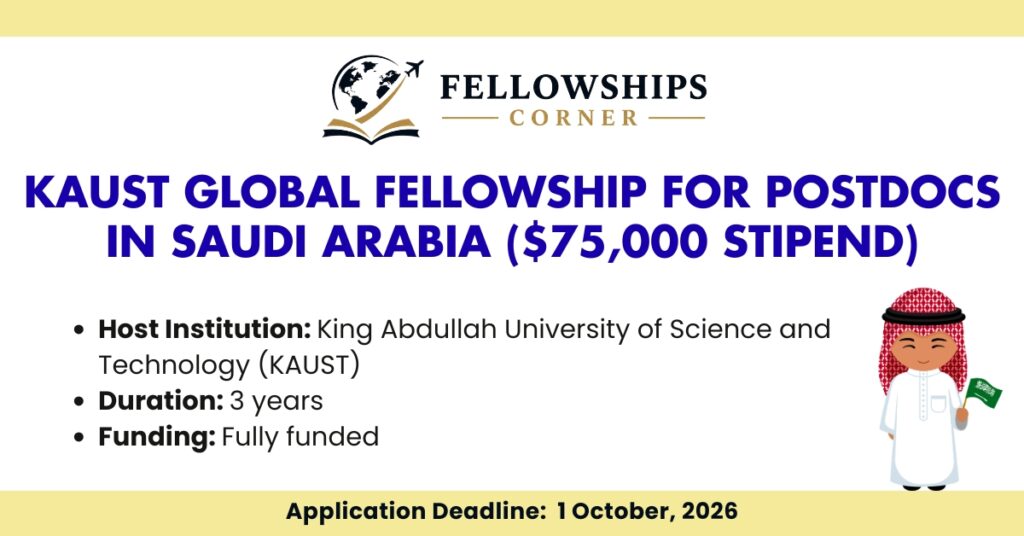
The window for the KAUST Global Fellowship opens on 1 September, and it closes on 1 October. That is thirty days to submit a concept note that decides whether you move forward or wait another full year. If you are a postdoctoral researcher who wants to run your own project instead of someone else’s, this is one of the few fellowships in the world that hands you the budget, the lab access and the title to do it.
Below is a plain explanation of how the program works, who it fits, what it pays, and how to plan your application before the clock starts.
Start With the Calendar, Not the Application Form
Most people lose this fellowship in August, long before they ever open the form. The two stage structure means you need your science, your host and your paperwork lined up early.
Stage 1: Concept Note
- Applications accepted from 1 September to 1 October
- This is your shorter pitch, and it is what gets you screened in or out
- Only applicants who clear this stage move forward
Stage 2: Full Proposal, by invitation only
- Applications accepted from 15 November to 15 January
- You cannot enter this stage directly, you have to be invited after Stage 1
- This is where your detailed research plan and budget live
KAUST also offers a “register your interest” option before the cycle opens. Use it. It costs you nothing and it puts you on the list for reminders and updates so you are not refreshing the page in September hoping you did not miss something.
What a Realistic Timeline Looks Like
- August: identify and contact your potential host Principal Investigator at KAUST, and rough out your research idea
- Early September: finalise the concept note with feedback from your host and a mentor
- Mid September: submit rather than waiting for the last day, since portals get slow and support desks get busy near deadlines
- November to January: if invited, build out the full proposal, the detailed budget and the supporting documents
The Host Principal Investigator Is Not a Formality
This is the part applicants underestimate. Your fellowship at KAUST is built around a host Principal Investigator whose research interests line up with yours. That person mentors you, backs your independence and helps you actually deliver the project on campus.
A cold email sent in late September is a weak start. A conversation that began weeks earlier, where the host has read your idea and told you which parts are feasible with the equipment available, is a much stronger one.
When you approach a potential host, keep it short and specific:
- Say what you work on now and what you want to test at KAUST
- Explain why their group in particular, referencing their actual published work
- Ask directly whether they would be open to hosting a Global Fellowship applicant this cycle
- Attach a one page summary of your idea rather than a full proposal nobody asked for
KAUST provides a “find your host” directory and public information on its research missions and Core Labs. Read those before you write, so your proposal is grounded in what the campus can genuinely support.
Who the Program Is Built For
The KAUST Global Fellowship Program is aimed at outstanding emerging research leaders from anywhere in the world. It is merit based, and the profile it looks for is fairly clear.
- Postdoctoral researchers in the early stage of their career
- Applicants with up to four years of postdoctoral research experience
- Scientists and engineers with a breakthrough idea, not a routine continuation of a supervisor’s project
- Research directions that complement, support and advance the major research priorities of KAUST
- Candidates ready to lead their own work rather than execute someone else’s plan
Nationality is not a barrier. KAUST hosts more than 110 nationalities on campus, and the fellowship is explicitly global in its recruitment.
What You Actually Receive
The package is designed so that money and logistics stop being the reason your research stalls. Funding runs for three years.
Money for you
- $75,000 USD annual living stipend
- Annual travel assistance
- Relocation allowance
Money for the science
- Up to $40,000 USD annual research budget attached to your own proposal
- Direct access to multidisciplinary laboratories on campus, equipped with current technology and staffed by specialists
- Support from your host Principal Investigator and experienced colleagues in the group
Life outside the lab
- On campus accommodation
- Comprehensive medical insurance
- Schooling for up to three children
- A cohort experience with other Fellows, so you are not isolated in a new country
Career growth
- The KAUST Mentoring Program
- The Harvard Higher Education Teaching Certificate
- Leadership programs and certificates
- Networking with KAUST research partners across academia, industry, government agencies and funding bodies
- Access to alumni of the fellowship who have already made the jump to independent roles
That last group matters more than people expect. Plenty of postdocs finish a well funded position with strong papers and no network, then struggle at the faculty application stage. A fellowship that deliberately builds teaching credentials, mentoring and international partnerships into the package is preparing you for what comes after, not just for three productive years.
Fellow Led Research Is the Real Selling Point
There is a meaningful difference between a postdoc position and a fellowship like this one. In a standard postdoc, you usually join a project that already exists, with aims already written by someone else.
As a KAUST Global Fellow, you design and lead your own original research from day one. You hold the budget for it. You build the record that funding panels and hiring committees look for later, which is evidence that you can define a question, secure resources and deliver results under your own name.
KAUST describes its environment as “research first,” and the practical meaning of that phrase is access. Equipment, Core Labs, technical staff and expertise are treated as things researchers should be able to use, not obstacles they have to negotiate around for months.
The program also sits inside a larger national picture. It is aligned with Saudi Arabia’s Vision 2030, which pushes research toward commercialisation, global partnerships and measurable economic and social impact. If your work has a translational angle, say so clearly in your application, because that alignment is part of what the program is trying to achieve.
How to Make Your Concept Note Stand Out
You are writing for reviewers who read a lot of these. Some practical guidance:
- Lead with the idea, not the background. Reviewers should understand what you are proposing within the first few lines.
- Be honest about feasibility. A three year plan that clearly fits the timeline reads better than an overambitious one that obviously does not.
- Connect to KAUST specifically. Mention the facility, the Core Lab capability or the host group that makes this project possible there and difficult elsewhere.
- Show independence. Make clear which parts of the idea are yours and how this moves you away from your PhD or current postdoc work.
- Explain the impact plainly. Who benefits, and how, if this works? Avoid jargon that only your subfield understands.
- Budget with reason. In Stage 2, a costed plan that matches your methods signals a researcher who has actually thought the project through.
A Quick Word on Scams
High value fellowships attract fake agents. Nobody legitimate will charge you a fee to apply for the KAUST Global Fellowship, guarantee you a place, or ask for payment to “process” your application. Apply only through official KAUST channels, and treat any request for money, cryptocurrency or personal banking details as fraud. If an offer arrives from an email address that does not belong to the institution, verify it before you respond to anything.
Frequently Asked Questions:
Is the KAUST Global Fellowship fully funded?
Yes. The program provides a $75,000 USD annual stipend, up to $40,000 USD in annual research funding, medical insurance, on campus accommodation, schooling for up to three children, a relocation allowance and annual travel assistance for three years.
How long does the fellowship last?
The fellowship runs for three years.
How much postdoctoral experience can I have and still apply?
The program supports postdocs with up to four years of experience, so it is aimed at researchers relatively early in their postdoctoral stage.
When do applications open and close?
Stage 1 concept notes are accepted from 1 September to 1 October. Stage 2 full proposals are accepted from 15 November to 15 January, and only from applicants who receive an invitation after Stage 1.
Can I apply directly to Stage 2?
No. Stage 2 is by invitation only, and invitations follow a successful Stage 1 concept note.
Do I need a host at KAUST before applying?
Your fellowship is structured around a host Principal Investigator with research interests similar to yours, so identifying and contacting a suitable host early is a serious advantage. Use the official “find your host” resources to shortlist groups.
Is the program open to international applicants?
Yes. It recruits outstanding early career researchers from around the world, and the campus community includes more than 110 nationalities.
Can I bring my family?
The benefits package includes on campus accommodation and schooling for up to three children, which indicates the program is designed with family relocation in mind. Confirm the specific dependent conditions with the official program team for your situation.
What kind of research does KAUST fund through this program?
Projects with breakthrough potential that complement, support and advance KAUST’s major research priorities. Reviewing the university’s research missions before you write will help you frame your idea in the right terms.
Is there an application fee?
Legitimate applications go through official KAUST channels and no third party should be charging you to apply. Treat any payment request as a red flag.
The KAUST Global Fellowship gives early career researchers something rare, which is real money, real facilities and permission to run their own project for three years, without the financial pressure that pushes so many postdocs out of research entirely.
The competitive part is not the paperwork, it is the idea and the fit. So start now, while the portal is still closed. Shortlist two or three potential host Principal Investigators this week, write a one page summary of your proposed project, and send those emails before September arrives. By the time Stage 1 opens, your concept note should be a refinement of something that already exists, not a document you are writing from scratch in a panic.
Bookmark the official KAUST Global Fellowship page, register your interest, and keep checking Fellowships Corner for updates on this and other fully funded opportunities.