
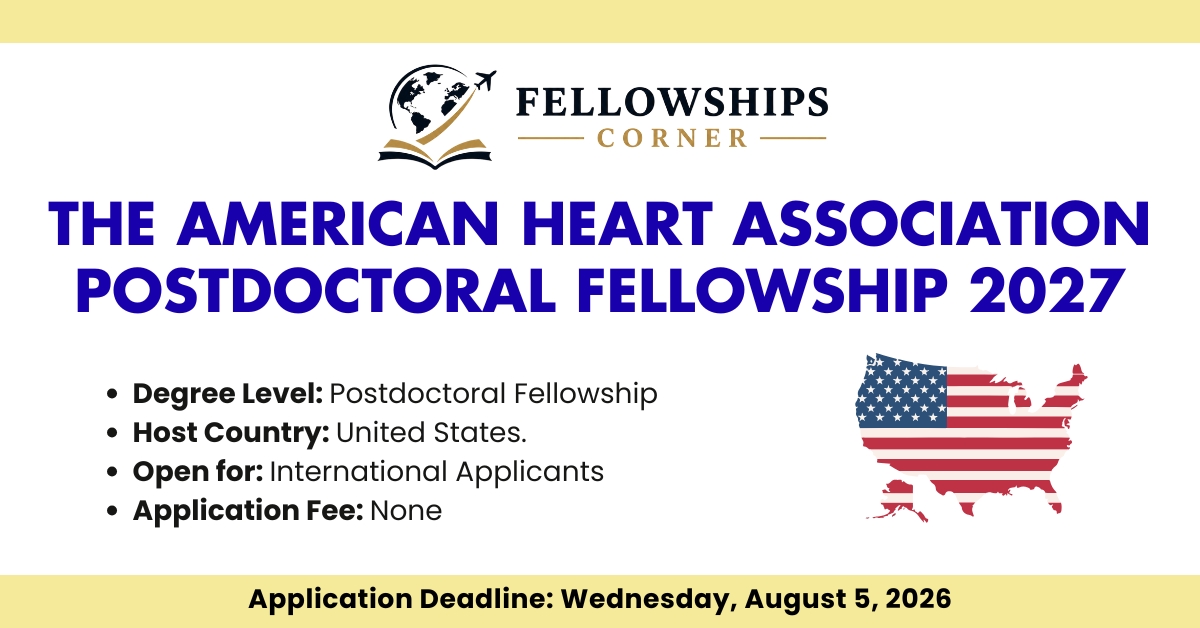
The American Heart Association Postdoctoral Fellowship 2027 hands early career researchers something rare in academic funding: a guaranteed stipend, health insurance, and project money, all wrapped around a structured mentor relationship instead of a solo grant chase.
If your work touches cardiovascular disease, cerebrovascular disease, or brain health, and you hold a doctoral degree, this is one of the most stable entry points into an independent research career. For more BS, MS,Phd, Postdoc Positions visit here.
The Fellowship in Plain Terms:
Strip away the paperwork and this program does one thing: it pays a postdoc’s salary so they can train full time under an experienced mentor rather than juggling grant writing and lab work alone. The Association built in flexibility for clinicians balancing patient care with research, including the option to delay a start date by up to six months.
Your project has to connect to cardiovascular, cerebrovascular, or brain health science, but you do not need to already sit inside a cardiovascular focused department to qualify.
Three Boxes You Must Tick Before You Apply:
Skip ahead and write a five page proposal only to discover you were never eligible, and you have wasted a summer. Check these first.
- You hold, or will hold by award activation, a post baccalaureate doctoral degree: MD, DO, DVM, PharmD, DDS, DPh, or a PhD in science, nursing, public health, or a related clinical field.
- You have five years or fewer of research experience since earning that degree, not counting clinical training, and you are not currently enrolled in a doctoral program.
- You can commit at least 80 percent of your time to research, and your home institution is a U.S. based nonprofit such as a university, medical school, or public hospital capable of hosting the project.
You are not required to live in the United States before submitting, but you do need an accepted immigration status at the time of submission, including U.S. citizen, permanent resident, or visa categories such as F1, J1, H1B, O1, TN, E3, G4, or DACA, maintained for the full award term.
Also Check: ISTA Fellow Postdoctoral Fellowship 2026 in Austria
The Stipend Ladder: What You Would Actually Be Paid:
Pay scales with your years of postdoctoral experience, not with your project’s ambition.
- 0 years: $63,480
- 1 year: $63,900
- 2 years: $64,380
- 3 years: $66,948
- 4 years: $69,180
- 5 years: $71,748
- 6 years: $74,424
- 7 or more years: $77,076
Beyond the base stipend, fellows receive $12,200 per year for health insurance and $3,000 per year in project support, with at least $1,500 of that earmarked for conference travel.
International travel is allowed without extra approval, and there is no ceiling on individual budget items. The Association does not cover indirect or overhead costs on this award, since it is designed primarily as salary support.
Mark These Dates in Red:
- RFP posted: April 28, 2026
- ProposalCentral opens: May 15, 2026
- Proposal deadline: Wednesday, August 5, 2026, at 3 p.m. Central Time
- Award notification: December 2026
- Award start: January 1, 2027
No extensions, no appeals, no late submissions accepted under any circumstance. Give your mentor, referees, and institutional signatory real breathing room before that August cutoff.
Also Check: Wang Gungwu Visiting Fellows Programme 2027
Why Your Mentor Matters More Than Your Publication List:
Reviewers do not just check whether you have a mentor, they scrutinize the relationship itself. Your mentor needs to be an established investigator who can point to a track record of funding, productivity, and trainees who succeeded after leaving the lab.
Because the fellowship pays only your stipend, the actual research budget for equipment, reagents, and lab operations has to come from your mentor’s existing grants, which means your project will usually extend work already underway in their lab.
What reviewers penalize is a training plan that reads like it was copied from another applicant’s file. Your mentor should be able to name specifically what you contributed to the proposal versus what guidance they provided, and how the project moves you toward your own career goals rather than simply advancing theirs.
One mentor can only supervise four Association funded fellows at once, so confirm they have room before you commit months to this.
Five Pages That Decide Everything:
The entire Research Plan is capped at five pages, structured in this exact order.
- Specific Aims: State what you are testing and tie it to your longer term career direction.
- Significance: Show you know the current literature, name the gap, and connect your project to the Association’s mission around cardiovascular and brain health.
- Preliminary Studies: New fellows rarely have their own pilot data, so it is acceptable to lean on data your mentor’s lab already generated, framed transparently.
- Approach: Lay out your methods, controls, and analysis plan in enough detail that a reviewer outside your subfield can follow it. If animals or human subjects are involved, explain how variables such as sex factor into your design.
Alongside the plan, you will submit three reference letters from people outside your mentoring circle, a biosketch with a personal statement on your career goals, and a description of your mentor’s research environment and facilities.
Also Check: OECD Co-operative Research Programme Fellowship 2027
From Login to Submit: The Application Timeline
- Confirm eligibility, then join or renew your American Heart Association Professional Membership immediately since processing takes three to five days.
- Link an ORCID iD to your ProposalCentral account, now a submission requirement.
- Once ProposalCentral opens on May 15, 2026, start your application under the Postdoctoral Fellowship program.
- Add your mentor, department head, and referees under Third Party Personnel and give them your personal deadline, well ahead of August 5.
- Draft and convert your Research Plan, Literature Cited, biosketch, and Summary for Non Scientists into PDF following the Association’s formatting rules.
- Complete your budget, science classifications, and organization assurance sections.
- Run the Validate check to catch missing pieces, then route the application to your grants officer for electronic signature.
- Submit before 3 p.m. Central Time on August 5, 2026, and log back in afterward to confirm the status reads Submitted.
What Separates a Funded Proposal from a Rejected One:
A few patterns show up again and again when comparing successful applications to weaker ones. The Summary for Non Scientists is graded for reading level automatically, and anything above 12th grade blocks submission entirely, so write it for a curious neighbor, not a colleague.
Feasibility carries more weight than novelty at this career stage; showing your mentor’s lab already has the samples, equipment, or technique needed for your aims reassures reviewers the timeline is realistic.
And because referees cannot include your mentor, co mentor, or anyone contributing to the proposal, applicants who wait until the last month to line up reference letters often scramble, since those outside relationships take longer to activate than an email the week before the deadline.
Also Check: The KAUST Global Fellowship Program 2027 in Saudi Arabia
Quick Answers:
What is the deadline for the 2027 AHA Postdoctoral Fellowship?
Proposals are due Wednesday, August 5, 2026, by 3 p.m. Central Time, with no extensions or late submissions accepted.
How much does the AHA Postdoctoral Fellowship pay?
The stipend ranges from $63,480 for applicants with no prior postdoctoral experience up to $77,076 for those with seven or more years, plus $12,200 per year for health insurance and $3,000 per year for project support.
Do I need to be a U.S. citizen to apply?
No. You can apply from outside the United States, but you must hold an accepted status such as U.S. citizen, permanent resident, or an eligible visa category, and maintain it throughout the award.
Can I hold this fellowship alongside another AHA award?
No. A Postdoctoral Fellowship awardee cannot hold another Association award concurrently, though you may apply for a subsequent award during your final fellowship year.
How long does the award last?
One or two years initially, with the option to apply for a second two year term later, up to a maximum of four years of Association funded postdoctoral support total.
Who is allowed to write my reference letters?
Anyone familiar with your scientific work and abilities, except your mentor, co mentor, department head, or any collaborator or consultant listed on the proposal.
Editorial note before publishing: confirm the ProposalCentral opening date and deadline time zone against the live Association page, since RFP details can be revised, and insert the correct application portal link where marked below.
Apply here: https://professional.heart.org/en/research-programs/aha-funding-opportunities/postdoctoral-fellowship
Also Check: JSPS Postdoctoral Fellowships for Research in Japan 2027
