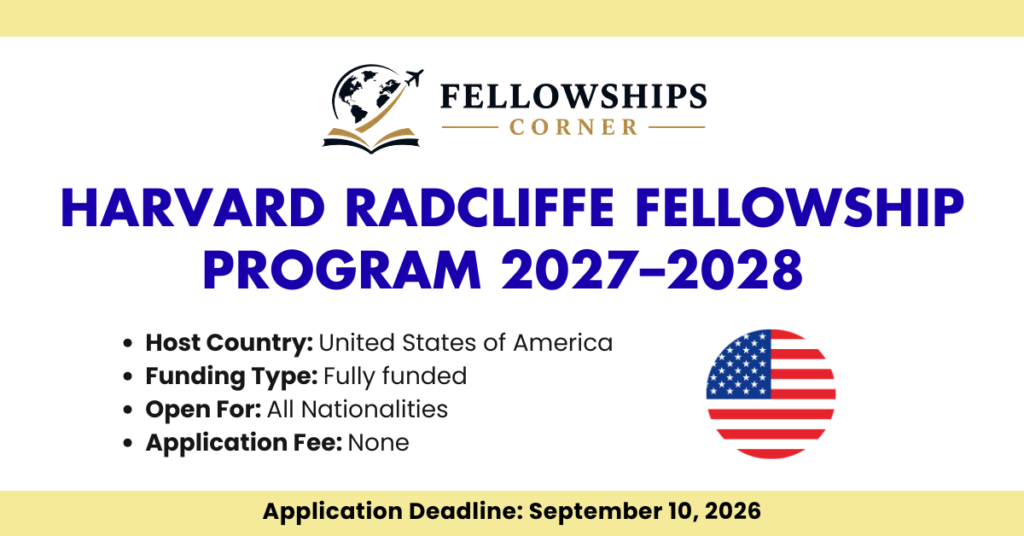
Harvard University, through its Radcliffe Institute for Advanced Study, has opened applications for the Harvard Radcliffe Fellowship Program 2027–2028. This is one of the most prestigious fully funded fellowships in the world, designed for scholars, scientists, writers, journalists, artists, and public intellectuals who want a full academic year to pursue an ambitious project without the usual pressures of teaching, grant cycles, or daily work obligations.
Each year, around fifty fellows are selected from across the humanities, social sciences, sciences, engineering, mathematics, creative arts, journalism, and nonfiction writing. Successful applicants receive a generous stipend, dedicated workspace at Harvard, full access to Harvard’s libraries and research facilities, and the chance to be part of an interdisciplinary community of thinkers for an entire year.
This article breaks down everything you need to know about the fellowship, including eligibility requirements, application materials, deadlines, benefits, and the selection process, so you can decide whether to apply and prepare a strong submission.
What Is the Harvard Radcliffe Fellowship?
The Harvard Radcliffe Fellowship Program is run by the Harvard Radcliffe Institute, which serves as Harvard University’s institute for advanced study. The Institute’s mission is to create and share transformative ideas across the arts, humanities, sciences, and social sciences, and the Fellowship Program is central to that mission.
Fellows are given the rare opportunity to step away from their usual professional commitments for nine months and focus entirely on a single project. The program is intentionally multidisciplinary, bringing together people from very different fields so they can learn from one another and form new collaborations.
The Institute is also home to the Arthur and Elizabeth Schlesinger Library on the History of Women in America, one of the foremost archives of women’s history in the country. While applicants are not required to focus on women, gender, or society, this remains a strong area of interest given the Institute’s history.
Who Can Apply?
Eligibility requirements differ slightly depending on your field, but a few rules apply to everyone.
General Eligibility Rules
- If you are currently enrolled in a PhD or Master’s program, you are generally not eligible to apply, even if you expect to graduate before the fellowship begins. The only exception is if your dissertation has already been accepted, your degree is forthcoming, and you meet the field specific eligibility requirements described below.
- This fellowship is not designed to function as a postdoctoral fellowship. Applicants are expected to demonstrate an independent and substantial body of work.
- You do not need to hold a position at a university or research institution. Independent scholars, artists, and writers are welcome to apply.
- Applicants from any country in the world may apply. Harvard typically sponsors J1 scholar visas for international fellows.
- Former Harvard Radcliffe Fellows, meaning anyone who has held the fellowship from 1999 to the present, are not eligible to apply again.
Discipline Specific Eligibility
Humanities and Social Sciences
- You must have received your doctorate in the area of your proposed project at least four years before your appointment as a fellow. For the 2027–2028 fellowship year, this means your doctorate must have been completed by December 2023.
- You must have published a monograph, or at least two articles in refereed journals or edited collections.
Science, Engineering, and Mathematics
- You must have received your doctorate in the area of your proposed project at least four years before your appointment as a fellow, meaning by December 2023 for this cycle.
- You must have published at least five articles in refereed journals.
Journalism
- You must have worked professionally as a journalist for at least five years.
Nonfiction
You must meet at least one of the following:
- You have one or more published books.
- You have a signed contract for the publication of a book length manuscript.
- You have published at least three shorter works that are longer than typical newspaper articles.
Fiction
You must meet at least one of the following:
- You have one or more published books.
- You have a signed contract for the publication of a book length manuscript.
- You have published at least three shorter works that are longer than typical newspaper articles.
Poetry
- You must have had at least 20 poems published, or a full book of poetry published, within the last five years.
- You must currently be working on completing a manuscript.
Playwriting
- You must have a significant body of independent work in this form, which typically includes plays that have been produced or are currently under option.
Film and Video
- You must have a body of independent work that demonstrates significant achievement, typically shown through exhibitions in galleries or museums, screenings at film or video festivals, or television broadcasts.
Visual Arts
- You must show strong evidence of professional achievement, including at least five years of work as a professional artist, participation in several curated group shows, and at least two professional solo exhibitions.
Music Composition
- A PhD or DMA is desirable but not required.
- You must demonstrate strong evidence of professional achievement as a composer, including a record of recent performances of your work.
Can I Apply as Part of a Group?
Yes. The Radcliffe Fellowship accepts group applications involving up to two individuals. If selected, the group will take up two fellowship spots, meaning two stipends and two offices, since each member is treated as an individual fellow. Both members of the group must independently meet the eligibility requirements for their respective fields, and the two applicants must commit to working collaboratively on the same project throughout the entire fellowship year.
To apply as a group, follow these steps.
- Each member of the group must individually register on the application portal and submit a separate application.
- On the General Information page, under the question asking whether you are applying as an individual or a group, select Group, and list your collaborator’s full name, email address, and application ID. Every application is assigned a unique ID, which can be found on the My Applications page of the portal.
- Each group member must submit their own individual CV and writing or work sample.
- Both group members should upload the same project proposal, with a note explaining the nature of the collaboration.
- Applicants are encouraged to request letters from different recommenders for each group member. However, if a single recommender is well positioned to speak to the project as a whole, or has worked closely with both members, that person may serve as a recommender for both applicants and submit the same letter for each.
What Disciplines Are Supported?
Radcliffe Fellows come from an extremely wide range of fields across the arts, humanities, social sciences, and sciences. A full and current list of disciplines is available on the official application portal’s disciplines listing page.
If your work is interdisciplinary, you are allowed to designate one primary discipline and an additional disciplinary area. The additional area can be selected from a drop down menu, or you may write in your own description by selecting Other. It is advisable to select the discipline that best matches your proposed project, your professional or artistic background, and the discipline for which you meet the eligibility requirements. The Institute actively welcomes work that crosses disciplinary boundaries and makes an effort to find reviewers with the right expertise to properly evaluate such applications.
A Note for Scientists
For applicants in science, engineering, and mathematics, the Institute is especially interested in a few kinds of projects.
- Scientists who want to write a book reflecting on the broader implications of their research, or who want to communicate their work to a wider audience.
- Scientists whose projects cross disciplinary lines.
- Projects that do not depend heavily on laboratory infrastructure, such as research in theoretical fields, data science, computer science, mathematics, and statistics.
- Projects involving collaboration with a lab or research group based locally in Boston.
If your project depends on collaborating with a Boston based lab, you are required to contact a potential host lab before submitting your application. In this case, one of your three letters of recommendation must come from the host of that local lab.
For scientists who run a lab at their home institution, previous fellows have managed their labs remotely by setting up regular videoconference meetings with lab members, establishing clear expectations with collaborators about availability, and traveling back to their labs once or twice a year, typically during the program’s scheduled breaks. The fellowship calendar includes a five week winter break and a one week break in March.
Application Materials
A complete application to the Harvard Radcliffe Fellowship Program includes the following components, all submitted through the online application portal.
- A completed application form.
- A curriculum vitae.
- A project proposal.
- A writing or work sample, with requirements that vary by discipline.
- Contact information for three references, who will receive an automated email prompting them to upload a letter of recommendation.
If you have applied in a previous year, you are allowed to submit a previously proposed project again, but you must still complete a new application form and resubmit all required materials.
Curriculum Vitae
Your CV should be no longer than six pages. Focus on your most significant achievements, publications, exhibitions, and related accomplishments rather than trying to list everything.
Project Proposal
Your project proposal is the heart of your application. It should begin with a 150 word abstract that any reader, regardless of discipline, can understand. The Institute recommends structuring the abstract as follows.
- One to two sentences introducing your field in general terms.
- One to two sentences clearly describing the project you are proposing.
- One sentence describing the materials, sources, or archives you plan to use.
- Two to three sentences explaining how the project will contribute to your discipline, or to society more broadly.
The body of the proposal should describe the project and explain its significance, place the work within the context of your field, indicate how the project will contribute to that field, clearly explain your theory and methodology, cite relevant work by others where appropriate, and describe the current status of the project, including any work already completed or data already collected.
Write for an informed but broad audience outside your specific subfield. Initial reviews are conducted by experts in your discipline, but finalists are reviewed by a multidisciplinary committee, so clarity matters at every stage.
The full proposal, including the abstract, must not exceed 1,400 words. It should be formatted in 12 point font, double spaced, with one inch margins. Footnotes and works cited lists are not counted toward the word limit. You may include images, but it is recommended that you compress them so the file does not exceed the 10 MB upload limit.
A bibliography is optional, and not every project will require one. Most applicants in the humanities and social sciences include a bibliography of one to three pages. There is no required format. The bibliography helps reviewers understand how your project fits within current scholarship, and you may submit either a list of works you have already consulted or works you intend to consult, as long as you clearly indicate which one it is.
The Institute does not provide sample proposals from past applicants. However, every fellow who has completed a residency has a short project description published on the Radcliffe website, which can give you a sense of the kinds of projects the Institute supports.
Work Sample
The required work sample depends on your discipline.
- Humanities and social sciences: Submit writing related to your proposed project if you have any completed, even if unpublished. Otherwise, submit a published article or book chapter. The maximum length is 40 pages.
- Science, engineering, and mathematics: Submit three published articles.
- Nonfiction: Submit a recent book chapter, short story, manuscript, or article totaling approximately 30 pages. The material should relate to your proposed project, unless it is published work.
- Journalism: Submit three substantive published articles totaling approximately 30 pages. You may also submit up to 15 minutes of audio or video work via YouTube, Vimeo, or SoundCloud through the Journalism Supporting Materials Upload page.
- Fiction: Submit a recent book chapter, short story, manuscript, or article totaling approximately 30 pages. The material should relate to your proposed project, unless it is published work.
- Film and video: Submit a maximum of 15 minutes of work via YouTube or Vimeo through the Film and Video Supporting Materials Upload page. If your full sample runs longer than 15 minutes, provide timestamps indicating which 15 minutes you would like reviewers to watch.
- Music composition: Submit one to three samples of recent compositions via SoundCloud, YouTube, or Vimeo through the Music Supporting Materials Upload page. All samples should include written scores, except for electronic or improvisational pieces.
- Playwriting: Submit one play, or a section of a play, totaling no more than 30 pages.
- Poetry: Submit up to 10 poems.
- Visual arts: Submit 12 images and, if applicable, up to 3 moving image excerpts through the Visual Arts Supporting Materials Upload page.
You are allowed to combine more than one piece of writing into a single work sample, as long as the combined total stays within the page limit for your discipline, and all pieces must be uploaded as a single file.
Page limits are encouraged but not strictly enforced. Submitting a sample that is slightly over the limit will not disqualify your application, although reviewers may become frustrated with samples that run significantly long.
All application materials, including the work sample, must be submitted in English. Materials in other languages, including translated materials, are not accepted.
How to Start Your Application
If this is your first time applying, register as a new user on the online application portal using your name, email address, mailing address, and a password. After registering, log into the portal and select your application area, choosing between Humanities and Social Sciences, Creative Arts, Journalism and Nonfiction, or Science, Engineering, and Mathematics.
One section of the application asks you to list any additional required resources. This question exists so the Institute can assess what kind of software or hardware support you will need and determine what can be accommodated at Harvard University.
Letters of Recommendation
Applicants must submit exactly three letters of recommendation. No more than three will be accepted.
When choosing recommenders, request letters from people who can speak to the merits of your proposed project, your record of achievement, and your collegiality. The Institute also offers the following guidance.
- No more than one of your three recommenders should be from your home institution.
- No more than one recommender should be a member of your dissertation committee.
- If you are more than five years past your PhD, you should generally avoid asking your dissertation advisor for a letter, barring special circumstances.
- Lab based scientists whose projects involve collaboration with a local Boston lab must include a letter of support from the host of that lab as one of their three letters.
- Applicants in writing fields should avoid requesting letters from current editors or agents who may have a conflict of interest.
Requesting Letters Through the Portal
On the Listing of Recommenders page within the application portal, select Add Recommender and fill in the required information for each person. Once you click send, your recommender will receive an email with instructions for uploading their letter. Double check each recommender’s email address before sending the request, since incorrect addresses are the most common cause of delayed letters.
You can track the status of your recommendation letters at any time, even after you have submitted your application, by clicking Pending Letter of Recommendation in the portal. A status of “not received” means your recommender has gotten the request but has not yet submitted their letter.
If a recommender says they never received the request, first confirm that you entered their email address correctly. If the address is correct, resend the request and ask them to check their spam or junk folder. If they still cannot access the instructions, you can submit a request for help through Harvard Radcliffe’s support form.
Please note that letters from dossier services such as Interfolio are not accepted. The Institute also does not forward your full application materials to your recommenders automatically, so you should reach out to them directly with any context they may need to write a strong letter.
Key Dates and Deadlines
Application deadlines vary depending on your discipline.
- Humanities, social sciences, and creative arts (including journalism and nonfiction): Thursday, September 10, 2026, by 5:00 PM ET.
- Science, engineering, and mathematics: Thursday, October 1, 2026, by 5:00 PM ET.
Letters of recommendation are due by the same deadline as your application, so it is important to notify your recommenders well in advance so they have enough time to write and submit their letters.
Applicants will be notified of the outcome of the selection process by email in March 2027.
The fellowship itself runs for a full academic year, from September 2027 through May 2028.
What Does the Fellowship Provide?
Selected fellows receive substantial financial and institutional support.
- A stipend of $78,000.
- An additional $5,000 to help cover project related expenses.
- Additional funds to assist with relocation.
- Office or studio space in Byerly Hall, located in Radcliffe Yard.
- A full time Harvard appointment as a visiting fellow, which grants access to Harvard University’s libraries and athletic facilities.
- The ability to hire Harvard undergraduate students as Research Partners, with their hourly wages covered by the Institute.
- Access to professional development and engagement opportunities throughout the fellowship year.
US citizens or permanent residents coming from a home institution based in the US may choose to have their stipend paid either through their home institution or directly to them.
Support for Families
Fellows who relocate with a spouse, partner, or children can take advantage of several additional benefits.
- Spouses or qualified domestic partners of current Harvard ID holders may apply for borrowing privileges at Widener Library.
- Family members of fellows may sit in on regular lecture courses in the Faculty of Arts and Sciences, as well as some other graduate schools, at the discretion of the relevant faculty member.
- Fellows are eligible to purchase a family membership covering spouses, partners, and dependent children under 26 for use of Harvard Recreation facilities.
- The Fellowship Program provides funds to help eligible fellows cover dependent childcare costs.
- Some talks and events throughout the year are open to spouses and partners, and families are invited to various engagement activities during the fellowship year.
Life as a Radcliffe Fellow
Throughout the fellowship year, fellows present their work in progress, either through a private talk for their cohort or a public lecture. Group lunches are held twice a week, giving fellows regular opportunities to connect with one another, and fellows are encouraged to attend events happening across the wider Institute throughout the year.
Because the program places a strong emphasis on community and interdisciplinary engagement, fellows are expected to limit travel to the program’s scheduled breaks, which consist of five weeks in winter and one week in March. If a fellow needs to be away from the Institute for more than two weeks during the term, permission from the Executive Director is required. The Institute notes that a fully present cohort is essential to building the kind of generative, interdisciplinary community that defines the Radcliffe experience.
How Applications Are Evaluated
Every application goes through a two tiered review process.
- Experts in the relevant field review the application first.
- A multidisciplinary committee then selects a diverse class of fellows representing the highest levels of achievement and potential.
Applications are evaluated on the quality and significance of the proposed project, as well as the applicant’s intellectual or creative capacity, as demonstrated by a strong record of achievement or extraordinary promise. The Institute seeks diversity across disciplines, career stages, and other dimensions, and places high value on collegiality and openness to cross disciplinary conversation, since fellows are expected to uphold high standards of professionalism, integrity, and respect throughout their time at the Institute.
Unfortunately, the Institute is not able to provide individual feedback on applications, whether or not you are selected.
If you are not selected in a given cycle, you are welcome to reapply in a future year. If you receive an offer from another fellowship while your Radcliffe application is still under review, you are asked to inform the Institute. If you decide to accept another fellowship before Radcliffe’s selection process is complete, you should let them know so your application can be withdrawn from consideration.
How the Fellowship Relates to Harvard Radcliffe Institute
The Harvard Radcliffe Institute serves as Harvard University’s institute for advanced study, dedicated to generating and sharing transformative ideas across the arts, humanities, sciences, and social sciences. The Fellowship Program sits at the center of this mission, supporting groundbreaking scholarship and creative work from a diverse class of fellows each year.
The Institute’s Academic Ventures and Engagement program brings together scholars from across Harvard and around the world for multidisciplinary collaboration, ranging from small intensive workshops to large public conferences. Radcliffe Fellows benefit from full Harvard appointments as visiting fellows, which give them access to the university’s libraries, housing resources, and athletic facilities, and they may audit courses offered by the Faculty of Arts and Sciences and other professional schools at the discretion of the relevant faculty member.
Final Notes Before You Apply
This is an exceptionally competitive fellowship, and careful preparation matters. Before submitting your application, keep the following in mind.
- Confirm that you meet the specific eligibility requirements for your discipline well before the deadline, since requirements such as the four year post doctorate rule are strictly applied.
- Begin contacting your recommenders early, since letters are due by the same deadline as your full application.
- Pay close attention to the word and page limits for your proposal and work sample, even though small overages will not disqualify you.
- Double check that all materials are submitted in English.
- If your project depends on a Boston based lab collaboration, reach out to a potential host lab before you begin your application, since this affects both your proposal and your choice of recommenders.
For the most current and complete information, applicants should refer directly to the official Harvard Radcliffe Institute Fellowship Program page before submitting their application, as program details can be updated by the Institute at any time.